When reviewing campus planning for primary and secondary schools, the clauses related to dormitories and dining facilities quickly connect to a much broader set of requirements: site safety, pollution control, sanitation, circulation, stair design, and wastewater treatment. These provisions in GB50099-2011 Code for Design of School are especially relevant because they affect not only layout decisions, but also whether later operation and management can work safely.
Site selection and external risk control
School campuses cannot be built in areas exposed to major natural hazards or high man-made risks, including earthquakes, geological collapse and fissures, underground rivers, flooding, or sites with excessive pollution. The required separation distance between the campus or school buildings and pollution sources must comply with current national control standards for each type of pollutant.
High-voltage transmission lines, long-distance natural gas pipelines, and oil pipelines are strictly prohibited from passing through or crossing a school campus. If they are routed near the school, the safety setback and protective measures must meet the relevant regulations.
For drinking water pipelines, the distance from outdoor public toilets, garbage collection stations, and other contamination sources must be greater than 25.00 m.
Dining hall planning: separation, supporting spaces, and hygiene
The canteen must also keep a distance of more than 25.00 m from outdoor public toilets, garbage stations, and similar pollution sources.
A school dining hall should not be combined with teaching rooms in the same building, and it is preferable to place it on the campus downwind side. Noise from the kitchen, as well as cooking fumes and odors, must not interfere with the teaching environment.
The required composition of the dining facility depends on the school type:
- In boarding schools, the dining hall should include a student dining room, a staff dining room, a meal distribution room, and a kitchen.
- In day schools, a meal distribution room, a food serving room, and a staff dining room should be provided.
The meal distribution room must contain a handwashing basin and a wash sink, and food reheating equipment is recommended.
The kitchen should also have attached spaces for rough vegetable processing and for storing sundries, fuel, ash, and similar materials. These support spaces must be arranged to avoid contaminating food, and they are preferably located near a secondary campus entrance.
Kitchen walls and the walls in the meal distribution room should be finished with a wall lining or washable wall surface to a height of at least 2.10 m.
Where a staff-only toilet is provided for the dining hall, that arrangement is considered preferable.
Student dormitories: what must be included and what must be avoided
Student dormitories may not be located in a basement or semi-basement.
Dormitories and teaching rooms should generally not be stacked together by floor within the same building. They may, however, be attached within one building volume if separated by a firewall. Dormitories must be capable of independent closed management, and they cannot share the same entrance with teaching areas in a mixed-use building.
Male and female student housing must be divided into separate zones, with separate entrances so that each area can be managed independently.
A student dormitory should include:
- sleeping rooms,
- a management room,
- a storage room,
- a cleaning tools room,
- shared washrooms,
- shared toilets.
It is also preferable to provide showers, a laundry room, and a common activity room.
Shared washrooms, toilets, and showers should preferably be arranged on each floor. The distance from the doors of washrooms and toilets to the dorm room doors must not exceed 20.00 m. If the number of boarding students on a floor is relatively large, these facilities may be arranged in groups. This limit does not apply to public areas that are not intended to serve students.
Dorm room size, occupancy, and storage
A student dorm room should house no more than 6 students.
The usable floor area per student should be no less than 3.00 m². This area figure does not include space occupied by storage.
Minimum clear room height depends on the bed type:
- at least 3.00 m with single-level beds,
- at least 3.10 m with bunk beds,
- at least 3.35 m with loft beds.
Storage space must be provided inside the dorm room. The recommended storage volume per student is 0.30 m³ to 0.45 m³, and both the width and depth of the storage unit should be no less than 0.60 m.
Clothes-drying space must also be provided for student dormitories. If balconies, exterior corridors, or rooftops are used for drying clothes, anti-fall protection measures are required.
Sanitary details that directly affect use
In school toilets, the distance from the squatting pan position to the rear wall must not be less than 0.30 m.
For rooms and floor areas exposed to water, slip resistance is mandatory, and indoor spaces should be equipped with trapped floor drains. This applies to:
- evacuation routes;
- corridors in teaching buildings;
- teaching and auxiliary rooms with water supply, such as science classrooms, chemistry labs, thermal labs, biology labs, art rooms, calligraphy rooms, and swimming pools or natatoriums;
- infirmaries or health rooms, drinking water points, toilets, washrooms, and shower rooms.
Windows, railings, and fall protection
For windows adjacent to an open drop, the sill height must not be lower than 0.90 m.
Accessible roofs, exterior corridors, stairs, platforms, balconies, and other exposed edges must have protective railings. These railings must be secure and safe, with a height of at least 1.10 m. At the weakest point, the railing must resist a minimum horizontal load of 1.5 kN/m.
Evacuation width and corridor dimensions
Inside primary and secondary schools, one unit of pedestrian flow is calculated as 0.60 m in width.
The minimum width of any means of egress must accommodate at least two units of pedestrian flow, and any increase in width should be made in whole multiples of 0.60 m.
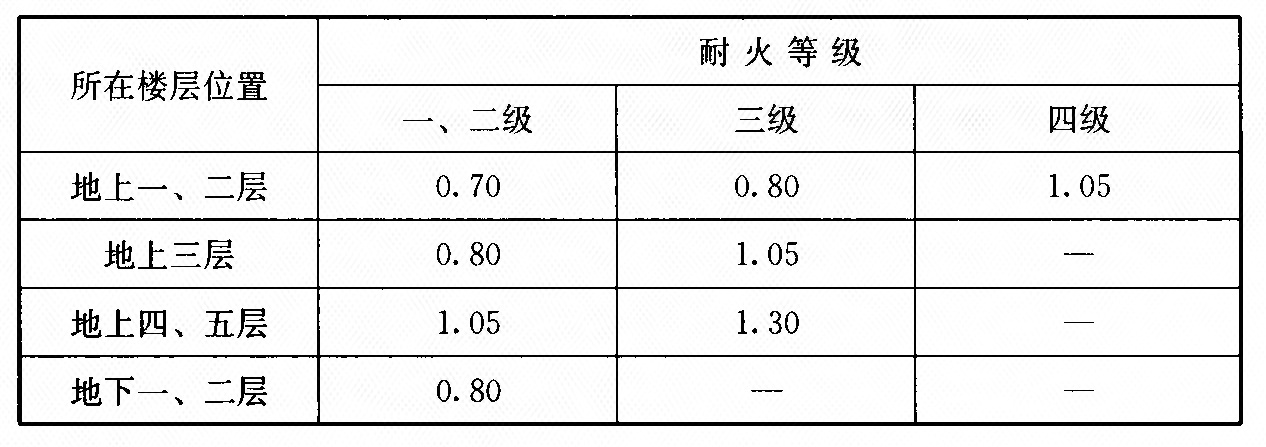
For exits, escape corridors, evacuation stairs, and room exit doors, the clear width required per 100 occupants must follow Table 8.2.3. At the same time:
- the clear width of an internal corridor serving teaching rooms must not be less than 2.40 m;
- the clear width of a single-loaded corridor or an exterior corridor must not be less than 1.80 m.
After a room egress door is opened, the clear passage width of each door leaf must not be less than 0.90 m.
Except for single-story buildings no larger than 200 m² with no more than 50 occupants, every building on campus must have two exits. In schools above the complete primary level, a low-rise building may have only one exit if its area does not exceed 500 m² and its fire-resistance rating is Class I or II.
Changes in level and ramp design
When a corridor inside a school building has a level change and steps are required, the stepped area must have natural daylight or lighting. There must be at least three risers, and winder steps are not permitted. If the level difference is less than three risers, a ramp must be used instead. The ramp slope must not exceed 1:8, and 1:12 or gentler is preferred.
Stair width, handrails, and stairwell safety
In teaching buildings, stair flight width must be an integral multiple of the pedestrian flow unit. The stair width must not be less than 1.20 m, and any increase should be made in whole multiples of 0.60 m. An additional swing width of up to 0.15 m may be added to each stair flight.
The clear width of the stairwell opening between two flights must not exceed 0.11 m. If it is greater than 0.11 m, effective safety protection measures are required. The clear horizontal distance between handrails of adjacent flights is preferably 0.10 m to 0.20 m.
Handrail requirements are tied directly to stair width:
- if the stair accommodates two pedestrian flow units, a handrail must be provided on at least one side;
- if the stair reaches three units, handrails must be provided on both sides;
- if the stair reaches four units, an intermediate handrail must be added, and the clear widths on both sides of that middle handrail must still satisfy the required stair width rule.
In addition:
- indoor stair handrail height must not be less than 0.90 m;
- outdoor stair handrail height must not be less than 1.10 m;
- horizontal handrail height must not be less than 1.10 m;
- stair railings may not use forms or decorative details that are easy to climb;
- the clear gap in baluster or decorative openings must not exceed 0.11 m;
- anti-sliding devices must be installed on school stair handrails to prevent students from sliding along them.
Wastewater treatment from labs and kitchens
Wastewater from chemistry laboratories must be treated before discharge into the sewage pipeline. Oily wastewater from kitchens and similar rooms must pass through grease removal treatment before entering the sewage system.
Taken together, these clauses show that dormitory and dining hall design cannot be considered as isolated room-planning problems. Their placement, supporting functions, circulation distances, protective details, and drainage treatment are all tied back to the larger logic of school safety and daily management.