By the first morning of the Lunar New Year, the village had already gone quiet. There had been a brief burst at midnight: I switched on the red lamp on the small shrine table, then firecrackers went off outside — flashes, noise, a short stretch of chaos — and then the world settled back into silence. The New Year, at least as something you could hear and feel, was over. This is not an exaggeration. Ten minutes later nobody was still setting off firecrackers, not even far away. There was nothing worth watching on television, so I turned off the light and slept.
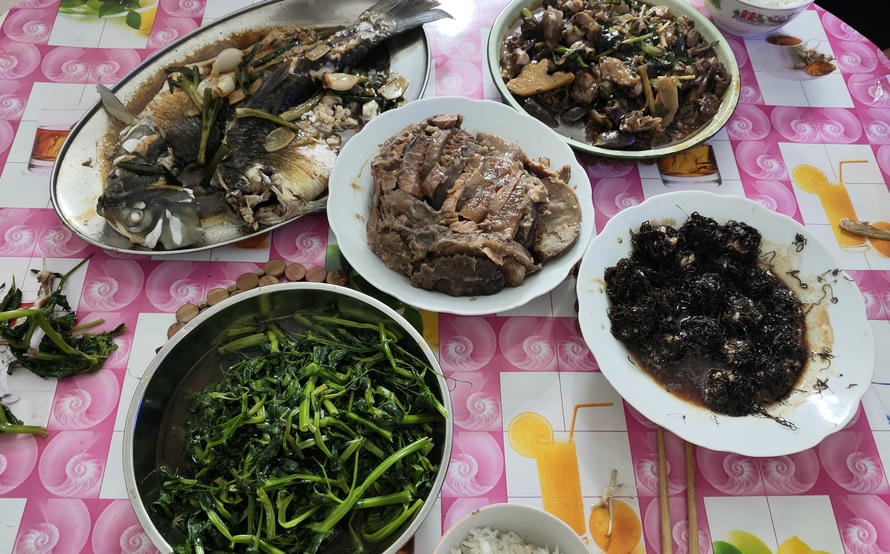
Normally custom would have sent people to a fixed spot in the village around midnight — whether it should be called an ancestral hall I am not sure, but I will call it that — to burn incense, light shrine candles, and burn paper offerings. But by then the village streetlights were off, the hall, though equipped with lights, did not seem to have its breaker switched on, and the walk would have been dark, with snakes possibly out. So the incense had to wait until morning.
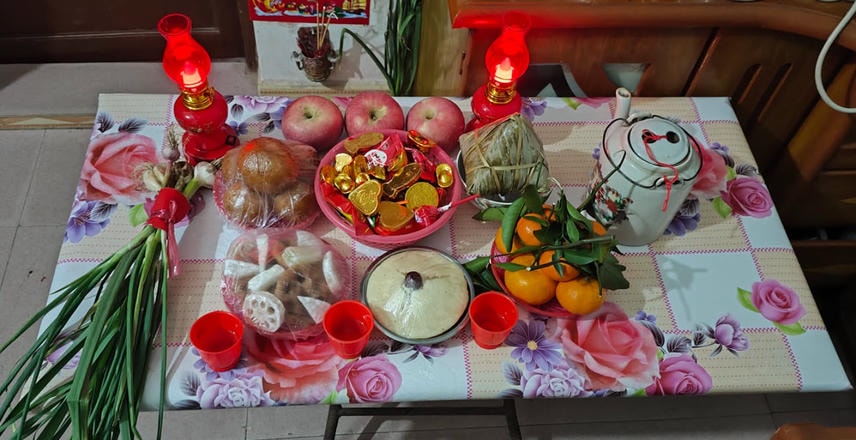
Apart from the opening firecracker custom and exchanging red envelopes, there was nothing: no decorations, no special activities, no particular rituals. The red paper from firecrackers stayed on the ground only because tradition says not to sweep on the first day. If you look tomorrow, the ground will be clean, the paper swept aside and bagged for fertilizer. I do not know exactly why it works as fertilizer — perhaps residual gunpowder, perhaps something else — but after the New Year I have seen it spread on fields, and even if it does little, it apparently does not harm the crops.
We did receive red envelopes. No kowtowing, no need to visit particular homes; people generally hand them over when they meet, and afterward you say a few nice things. That is basic courtesy, not worth making a big deal of. Since this is Guangdong, the amounts are small — five yuan, ten yuan — and I do not think that is a bad thing. When your turn comes to give them out, you may find that these small, light gifts are a quietly humane arrangement.
A village of fewer than ten
My hometown is a remote mountain village. This year made me realize how empty it has become: in this cluster of houses, including me, there are no more than ten people. They are scattered — a few in my house, a few next door, then a long run of empty homes before another household appears.
It is strange to think that this place has always been remote; internet access simply creates the illusion that it has joined the world. I say this without complaint, since I am benefiting from a stable connection right now — a 50 Mbps cable line, modest but enough for most online applications. Without that connection, whether broadband or mobile data, the village would probably feel truly cut off.
Travel is inconvenient, daily life is inconvenient, and the nearest city or fairly developed county town is close enough. So rural hollowing is severe. Young people leave to work elsewhere, settle there, move their household registration. For people of my generation, the only remaining link may be the ancestral-place field in the household register and perhaps the local dialect; otherwise there is little visible connection between us and the village.
There is a counterintuitive idea in human geography called the agglomeration shadow. Rural areas within a certain radius of a large city can experience economic decline rather than growth: vacant houses, unused fields, left-behind elderly people and children whose parents work away. The logic is not hard to follow. People from surrounding villages go to the city for better opportunities, including better schooling for their children. The most direct result is a hollowed-out countryside.
I suspect my hometown sits in that shadow. Locally, transport is bad, but once you leave the village and reach the main road, a highway entrance is nearby; in about an hour by car you can reach major cities. In time-and-space terms, it fits the shadow almost perfectly. The lively New Year I remember from childhood may have existed because the village's young people had not yet established themselves in the cities and still came back for the holiday. In recent years, as they married, settled, and built lives there, the liveliness moved away with them.
Even riding an electric scooter a few kilometers to the town and circling it twice, I found it very quiet. No opera performances, no street parades. Down by the old street someone had a lion dance, but it looked like a private booking rather than a public celebration. The kind of village-wide, noisy communal Spring Festival atmosphere I have only seen on television. The county seat might have something similar, but it is no longer really rural, and it is far from here, so I do not count it.
The shops still open fell into a few categories. Three milk tea shops were open, with young people inside gathered around mobile shooter games. Four or five combined grocery-and-small-supermarket shops were open. The postal bank in town was open. Almost everything else had closed its doors: cooked-food shops, restaurants, the stalls in the market.
The incense order
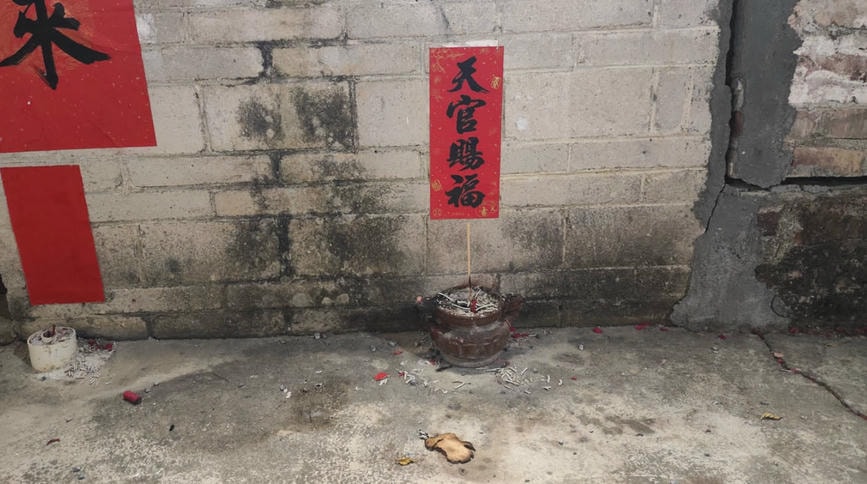
The incense ritual mentioned above is one of the few customs still holding on. Perhaps because it is relatively simple, the order is fixed in my mind. You carry offerings — usually a plucked chicken or goose briefly blanched in water, a pot of wine or tea, and some sweets or biscuits — to the ancestral hall. At the ancestor tablets near the entrance you burn incense, light candles (the kind used in shrines or ancestor worship), burn paper, and pour three cups of tea or wine. Then you repeat the same at Guanyin Bodhisattva to one side. Then at a tablet directly opposite the door outside. Then at the door gods at the hall entrance. Finally you set off two packs of firecrackers, and the ancestral hall part is done. On the way back, at another spot, you repeat the whole sequence for the Earth God and Earth Goddess, ending with two more packs of firecrackers. That completes the round.
I am not a scholar of religion, but the sequence makes me curious. It seems to show a kind of domestication of deities. Guanyin is a Buddhist figure, yet in a place with little Buddhist foundation she has been folded into folk belief and become a symbol of granting children, protecting women and children, and averting disaster. After the ancestral hall, there are more incense points at home. One is at the bedside of parents whose children are not yet married — the so-called Bedside Mother. This is not Chaoshan, Minnan, or Taiwan, so I can only read it as a cultural belief relatively common closer to Southeast Asia.
I do not mean to judge these customs. What worries me is that young people may forget old habits that are already close to disappearing in the countryside, and that the New Year here may eventually vanish too. Children today already have trouble understanding cash; handed a paper banknote, one might think it is a supermarket coupon. So I have a bold and rather frightening thought: one day a young person might come back for the New Year and ask, 'Do rural areas also read danmei novels? And why do people worship novel merchandise?' Following the pointing finger, I would see a cold incense spot with a red paper blessing pasted on it, mistaken for some kind of fan item.
I wanted to write more, but after turning it over for a while I had no good ideas. I cannot say whether this is a complaint or a helpless sigh. Since this is what is happening around me, I am writing it down.