Genetically modified food has a way of triggering a visceral reaction. The core fear is that eating it will change human genes, damaging health or reproduction. Biologists have a direct answer: digestion breaks food into amino acids, polysaccharides, fatty acids, nucleotides and other small molecules. Those are absorbed, enter cells, and are either rebuilt into the body's own components or burned for energy. Entire genes are not absorbed intact, inserted into cellular DNA, and expressed as inherited traits. The explanation has not convinced everyone. A familiar retort is that if experts are so certain, their own families should eat genetically modified food and nothing else.
The argument looks different when turned around. Genetic modification does not conjure a gene from nothing. It moves a gene from crop A into crop B so that B gains a trait such as disease resistance. If the genes in GM food could enter human cells and alter human heredity, then eating corn would make people carry corn genes and eating beef would make people carry cattle genes. Humans would have split into a range of different species long ago. They have not.
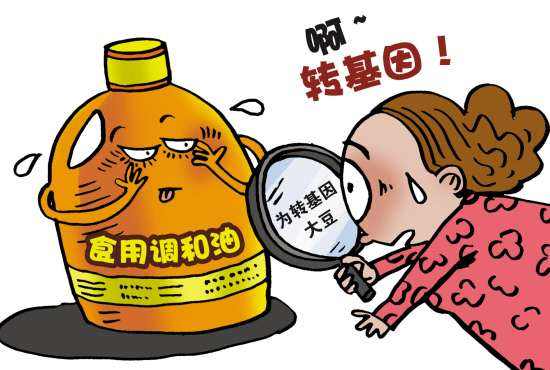
Does GM food harm human health?
The first point is narrow but important: the genes in GM food are not going to enter the human genome and affect inheritance. That does not prove every GM food is harmless. Many GM crops are engineered for disease or insect resistance. If a modified soybean kills insects that eat it, could it also harm people?
The usual explanation from crop scientists is that insect-resistant crops carry a specific gene sequence that produces a specific protein. The protein is meant to become active under alkaline conditions. Insect and human digestive systems are both acidic, but they differ in structure: an insect gut is a single straight tube, while the human system includes saliva and a strongly acidic stomach. By the time material reaches the intestine for absorption, the protein has already been broken down in the stomach. In insects, the protein binds to cadherin-like proteins in the gut and kills the insect. Humans do not have the same cadherin-like target, so the insecticidal protein has no effect on them. This is the theoretical basis on which crop scientists support transgenic breeding. It is not simply a trick to sell GM food.
Critics from other fields approach the question from a different direction. The human body is a complex organism, and only a small part of how it works is understood. If the unknown part cannot be shown to be safe, they argue, the precautionary principle says we should oppose GM food until harmlessness is demonstrated. For Bt protein, widely used in insect-resistant cotton and corn, doubts have been raised. Experiments have reported that Bt protein can stimulate the immune system of Yellow River carp, suggesting that it can affect the immune system of vertebrates (Yin Haicheng, Henan Agricultural Sciences, 2009). Other experiments have reported that Bt protein from certain strains, such as Bt9875, can induce apoptosis in HL-60 human cells (Zhu Lihong et al., Acta Microbiologica Sinica, 2008), which critics say demonstrates potential toxicity to humans. Heat-stability tests have also been questioned: not every Bt protein subtype has been tested, and at least one Bt protein in GM corn, Cry9C, can survive 90°C for 120 minutes without degrading. If such a protein carried a latent risk, residents above 3,000 meters could be widely affected.
The purpose of GM crops is to resist disease and insects and thereby raise yields to meet growing food demand. The controversy ultimately becomes a question of priorities: should society secure enough food first, or guarantee food safety first? At present, food sufficiency is not the main problem in many places, so opposition to GM food is intense. In a few decades, if population growth, ecological degradation, and lost farmland reduce food output, sufficiency may take priority over safety.
The short answer to whether GM food harms human health is therefore: under known conditions, no harm has been established; under unknown conditions, whether harm exists is unknown.
Where governments stand
About 75% of countries currently prohibit cultivation, including scientifically advanced countries such as Russia, Germany, France, the UK, Switzerland and Japan. The United States is the largest research supporter and cultivator of GM crops.
- United States: one of the most permissive regulatory systems in the world. Many biotech companies base their GM crop research there.
- Germany: legislation in 2009 banned GM crop cultivation and the domestic production, manufacture and sale of GM food.
- France: legislation in 2015 banned GM crop cultivation and domestic production and manufacture of GM food. Some GM food is imported.
- United Kingdom: bans GM crop cultivation and domestic production, manufacture and sale of GM food.
- Japan: with a large population and heavy food imports, Japan is cautious. It has not explicitly banned GM food, but it has not approved GM crop cultivation and strictly regulates imports.
- India: permits GM crop cultivation and GM food sales, and is heavily dependent on GM food.
- Russia: bans GM crop cultivation and production, while permitting imports of GM food.
- China: allows some GM crops, including cotton, papaya and certain vegetables; permits GM food sales; and allows legal research planting.
Switzerland, Austria, Hungary, Greece, Bulgaria and Luxembourg also ban cultivation, sale and production of GM crops and food. A European Commission survey found that 70% of Europeans did not want to eat GM food, and 94% wanted the right to choose whether to buy products containing GM material.
How much is grown, and where
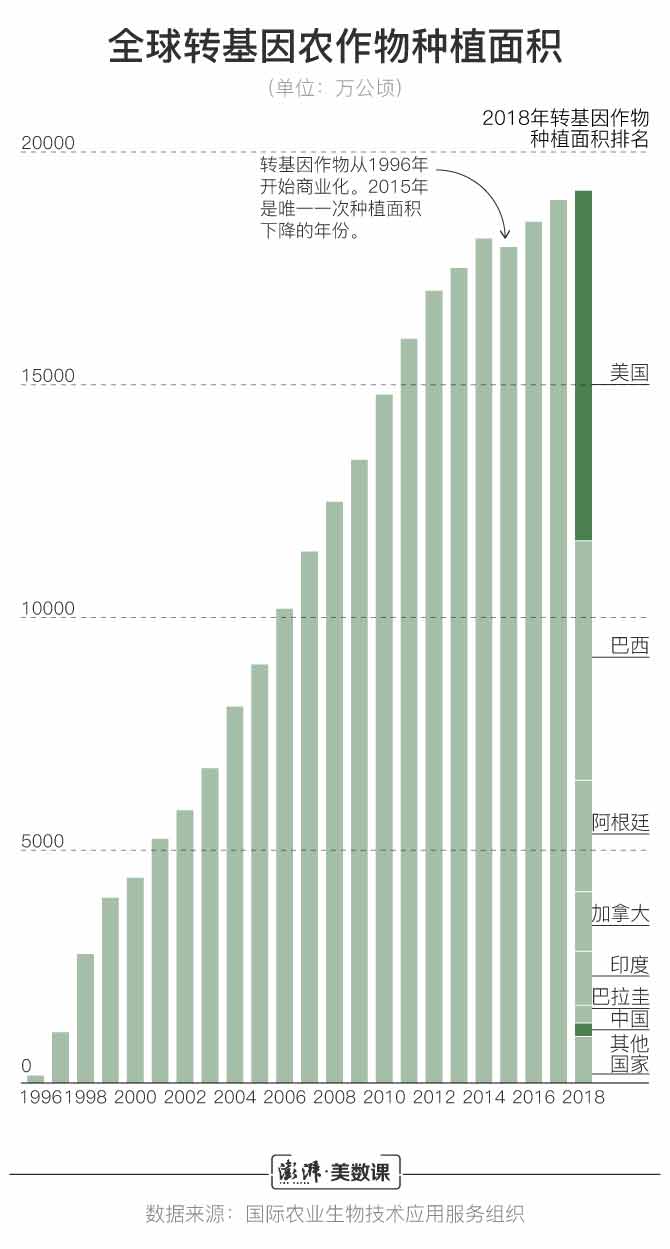
Global GM crop area is about 200 million hectares out of roughly 1.37 billion hectares of cropland, about 14.6%. The International Service for the Acquisition of Agri-biotech Applications (ISAAA), in its 2018 report on the global commercialization of biotech/GM crops, said GM crop area had grown about 113-fold since 1996, reaching a cumulative 2.5 billion hectares.
GM soybean is the leading GM crop globally, but in Asia-Pacific the dominant crop is still non-food cotton. In 2018, the United States had the largest GM crop area, 75 million hectares, mainly corn, soybean, cotton, sugar beet and six other crops. Brazil came second with 51.3 million hectares, mainly soybean, corn, cotton and sugarcane. Argentina was third with 23.9 million hectares, mainly soybean, corn and cotton. Canada was fourth with 12.7 million hectares, mainly rapeseed, corn, soybean, sugar beet, alfalfa and apple. India was fifth with 11.6 million hectares, mainly cotton.
China ranked seventh with about 2.9 million hectares, mainly cotton and papaya, the only two GM crops currently approved for cultivation. Although regulation is strict, GM corn in the northeast and GM rice in the south have been planted on a scale far beyond what the rules allow.
Which crops, and what traits
Corn, soybean, cotton and rapeseed have the largest area. GM soybean accounts for 50% of global GM crop area, followed by corn (58.9 million hectares), cotton (24.9 million) and rapeseed (10.1 million). In 2018, adoption rates were 78% for GM soybean, 76% for GM cotton, 30% for GM corn and 29% for GM rapeseed. Planting of GM alfalfa, sugar beet and potato increased, with average adoption above 90%.
The United States averaged 93.3% adoption for corn, soybean and cotton, a world leader. Argentina's adoption for soybean, corn and cotton was close to 100%. Canada averaged about 92.5% for corn, soybean, rapeseed and sugar beet. India's cotton adoption was about 95%. Globally, the main GM traits are insect resistance and herbicide tolerance.
China's imports
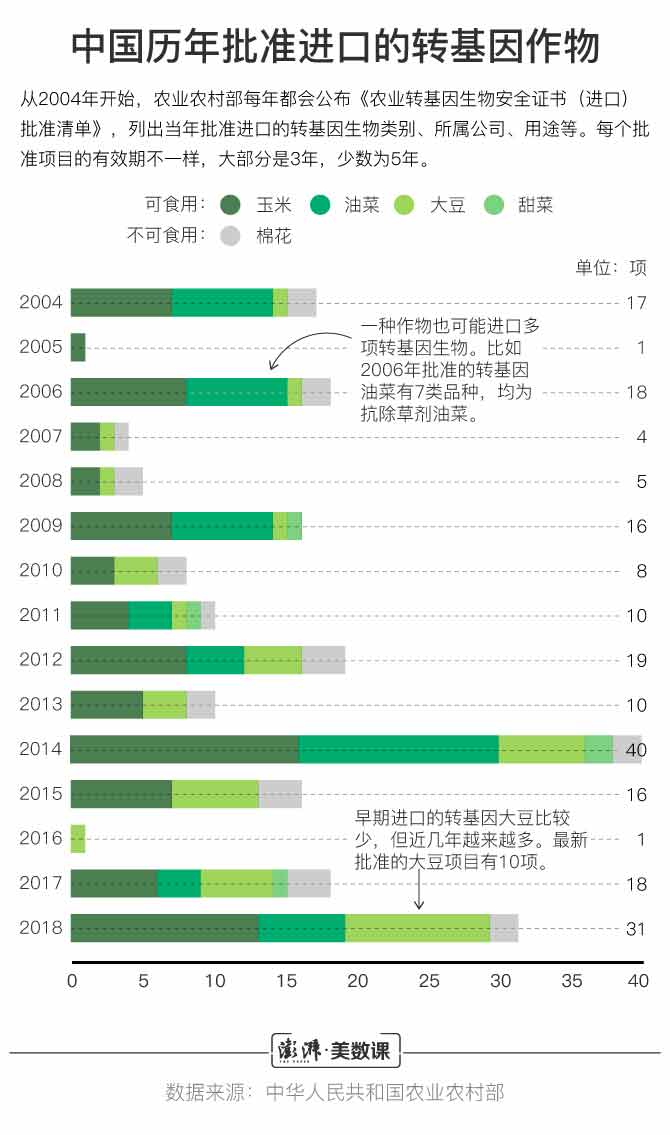
China grows few GM crops but has approved a growing and fluctuating number of imports. Since 2004, the Ministry of Agriculture and Rural Affairs has published an annual list of safety certificates for imported agricultural GMOs. Corn, rapeseed, soybean, sugar beet and cotton are the five main imported GM crops. One crop can receive multiple approvals in a single year. Early approvals were mostly for corn and rapeseed; in recent years, more soybean projects have been approved.
Chinese law says imported agricultural GMOs used as processing raw materials cannot be put to other uses. These crops are therefore rarely seen in ordinary markets; they are mainly used for animal feed, oil pressing and sugar production.
What Chinese consumers know
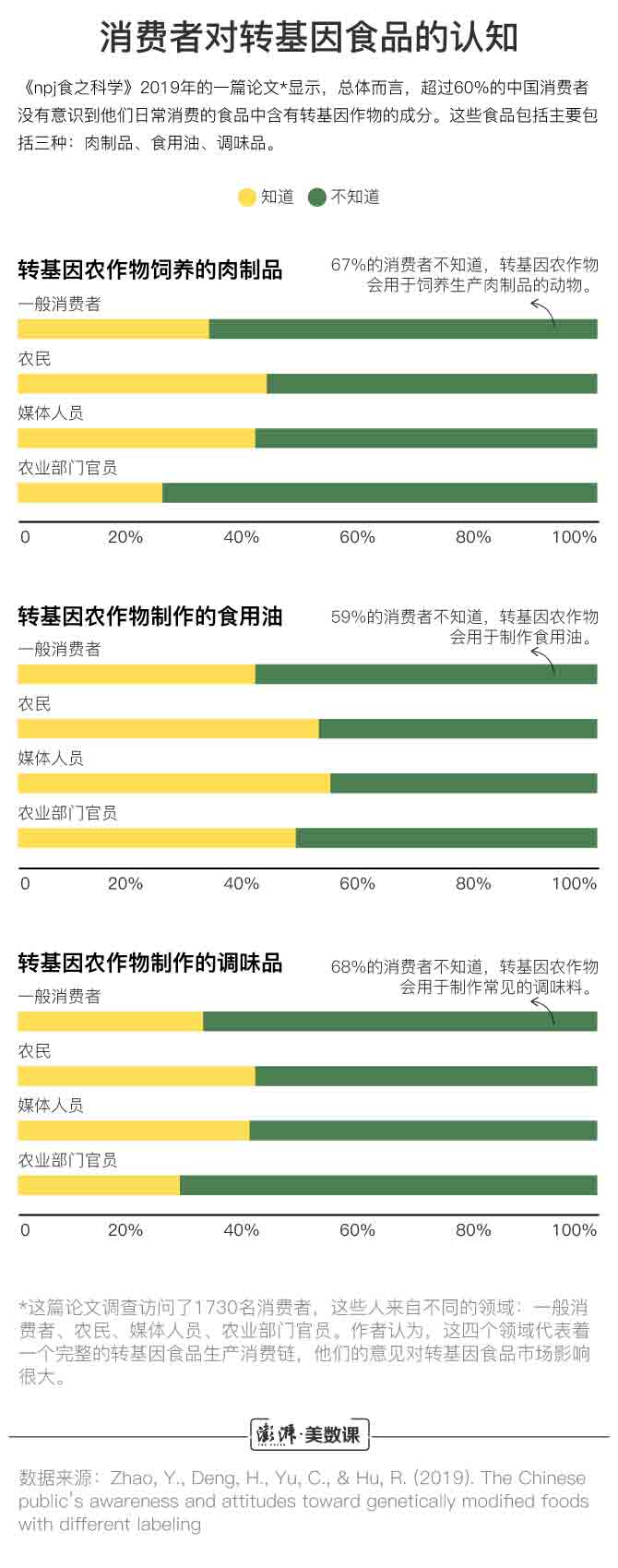
In 2002, the Ministry of Agriculture issued the Measures for Administration of Labeling of Agricultural GMOs and set the first labeling catalog. For 17 GM products in five categories sold in China, soybean, rapeseed, corn, cotton and tomato, labeling was made mandatory. Other GM agricultural products could be labeled voluntarily. Under the rules, food or feed made with GM crops must be labeled. But many consumers do not check labels, and some companies label poorly. As a result, many people do not know that they eat GM food or meat from animals fed GM feed. Most people in China eat GM food in daily life without knowing it.
A study published in npj Science of Food surveyed 1,730 Chinese consumers, including ordinary consumers, farmers, media personnel and agricultural officials. The authors treated these four groups as representing a complete GM food production and consumption chain. Ordinary consumers had weak awareness. About 68% did not know that GM crops such as sugar beet are used to make flavorings such as sugar. About 67% did not realize that GM crops such as soybean and corn are used to feed animals raised for meat.
Chinese attitudes
Since GM tomato entered commercial production in the United States in 1994, controversy has never really stopped. Support and opposition both exist, and opposition has generally been louder. China is no exception. Cui Yongyuan was for years a prominent anti-GMO campaigner. After he invested in a non-GMO food company whose prices were extremely high, he left the anti-GMO commercial alliance. He lacked biological expertise, relied on personal understanding and persistence, ran into difficulties in professional debates, and became entangled in commercial interests. Even so, his campaign made more people aware of what GMOs are and why some people oppose them, even if that opposition is not necessarily correct.
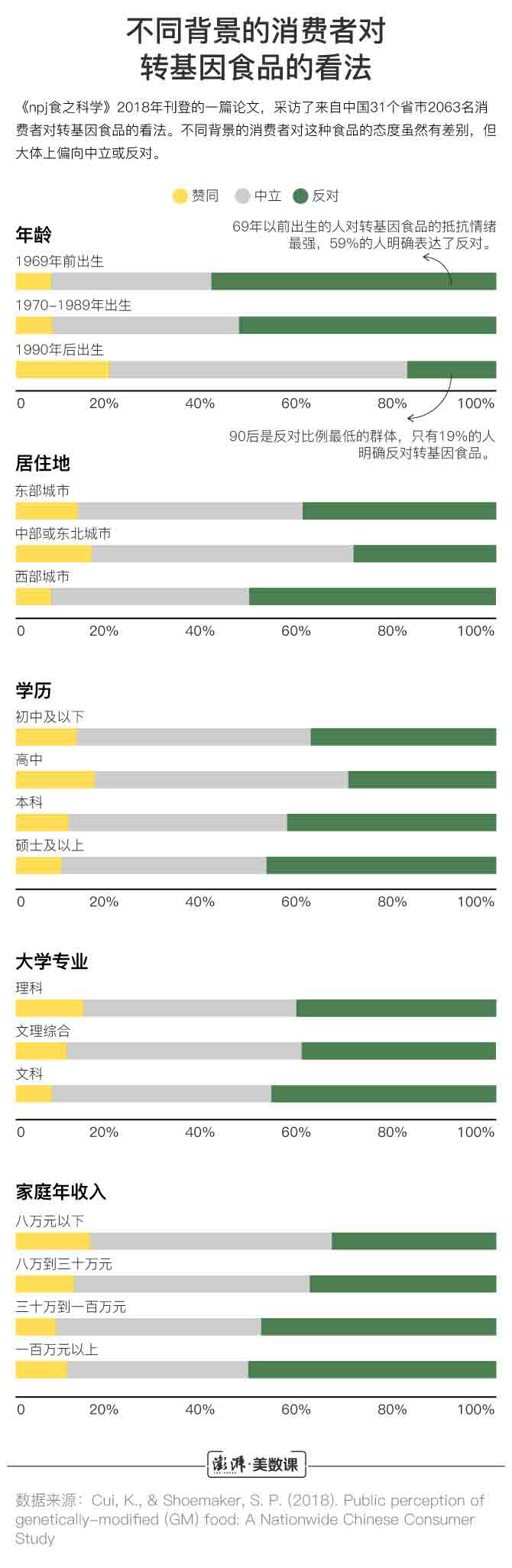
A second npj Science of Food paper surveyed 2,063 consumers across 31 provinces and municipalities. People born in the 1990s were least opposed to GM food; opposition rose with age. The west of China was more opposed, possibly because its sparse population makes food sufficiency less of a worry. College major had no clear effect. Liberal arts students were slightly more opposed, but the difference was not significant, perhaps because they are more emotionally oriented.
One result was unexpected: respondents with a master's degree or above, and those with household income above 1 million RMB, had the highest opposition within their groups. In other words, high-education and high-income groups were more strongly opposed. A common expectation would be the opposite: such people know more about the technology and social factors, and have a stronger sense of social responsibility, so they should support GM food. The survey found the reverse. Are they simply more protective of their own lives?
The Bt cotton episode in India
In 2002, Monsanto and its Indian partner Mahyco introduced Bt cotton seed and formed Mahyco Monsanto Biotech (MMB). Bt cotton greatly raised Indian cotton yields and became popular with farmers. Planting area expanded rapidly, reaching 8.381 million hectares by 2009, 87% of India's total cotton area of 9.636 million hectares. By 2016 it had risen to 10.8 million hectares, and India became the world's second-largest cotton producer.
Because the variety performed well, Bt cotton gradually came to dominate Indian cotton. Monsanto and its Indian partner repeatedly raised seed prices, peaking at 1,100 rupees for a 450-gram packet, including a royalty of 163 rupees. At the 2008 exchange rate, that was 162 RMB per packet, including 24 RMB in royalties. Planting one mu of cotton required about 1.2 kilograms of seed, so seed cost about 432 RMB per mu, with royalties of about 64 RMB.
Between 2002 and 2011, pest and climate problems repeatedly cut yields, and cotton price swings reduced incomes. Many farmers borrowed from banks. If the next year brought more disasters or lower prices, they could not repay. According to statistics, about 200,000 Indian cotton farmers committed suicide during this period because they could not repay bank loans. The 2011 documentary Bitter Seeds recorded the situation.
Indian and international media pointed at Monsanto, arguing that its Bt cotton royalties were too high. Monsanto faced global condemnation and multiple lawsuits. In August 2011, India saw nationwide protests under the slogan 'Monsanto, get out of India!' The Indian government forced the seed price down to 800 rupees and cut the royalty to 49 rupees per packet without consulting Monsanto. In 2018, the price was adjusted to 740 rupees for 450 grams, including about 39 rupees in royalties.
Were royalties the only reason for the suicides? Probably not. At the peak, the royalty was about 64 RMB per mu, while income from one mu of cotton was roughly 2,000 RMB. That share was high, but not enough by itself to drive farmers to suicide. Reports on the suicides mostly mentioned farmer debts of around $1,000. Suicide over $1,000 is not solely the original sin of Monsanto royalties.
This is not a defense of Monsanto. It is a reminder that media reporting can be partial or incomplete and can steer public attention in a particular direction. Ten years after the suicide crisis, more than 95% of cotton varieties planted in India still come from Monsanto Bt cotton or Indian-developed Bt cotton. The seed itself is clearly accepted in India. Bt cotton is not guilty as a technology. Monsanto's Bt cotton is a hybrid, so farmers cannot save seed; the Indian versions are self-pollinated varieties that allow seed saving.
In August 2016, Monsanto withdrew an application for a next-generation GM cotton seed in India, Bollgard II Roundup Ready Flex, delaying the new variety in the world's second-largest cotton-growing country. Indian domestic reaction was positive, with strong pressure to bring the new variety to market. The government still expects it, even though royalties may again be high.
A choice, not a blanket verdict
GM food is a new thing, and new things bring argument and bargaining between old and new views. The conservative side can easily attack a novelty for failing to follow ancestral rules, and the public is naturally conservative, so it is easily led. GM is new to all of humanity, yet in crops such as corn and soybean it already holds an absolute market share. It cannot simply be abandoned, just as India cannot abandon Bt cotton.
Since complete rejection is not realistic, the public should be given the right to know and choose. Exaggerating either harm or benefit hurts the public when results contradict the claims. Chinese media tend to prefer extremes, describing issues as black or white and rarely as gray. The world is mostly gray, but commercial incentives reward extremes because they attract attention. GM food has unfortunately been painted black and turned into a monster. In surveys, half of respondents clearly opposed GM food and only a little over 10% clearly supported it.
It is predictable that GM technology will not be completely rejected. It is more likely to be accepted passively: through clothing made from GM cotton, cooking oil made from GM soybeans, and sugar made from GM sugar beet. The facts will not change. What can change is how fully and objectively the public is informed, instead of being fed unproven dangers and pushed toward fear.