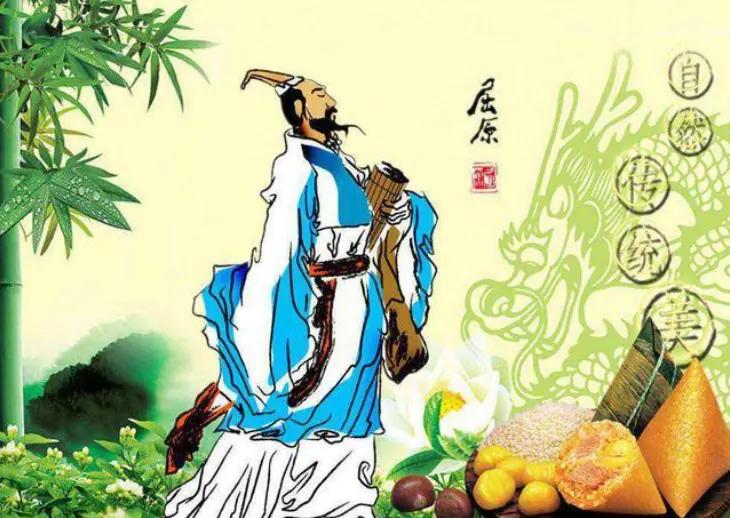
Yesterday was the Dragon Boat Festival, a day that ought to belong to remembrance.
I opened the bookcase, brushed away a thin layer of dust, and took out a slim copy of the Songs of Chu. In the cool summer morning air, I read in silence. Line after line, those ornate verses seemed to wake something long dormant. The outlines of memory sharpened; an elegy for an ancient gentleman rose and fell in the mind. And with it came a faint fragrance—the scent of forgotten herbs.
On this date 2,303 years ago, Qu Yuan cast himself into the river and completed the final transfiguration of his life. The old aristocrats of Chu had shown him coldness and suspicion, but the waters of the Miluo were not like them. In that last moment, they must have seemed gentle as a mother. So he let that clear river, as pure as his own convictions, close around him, and drifted into a long sleep inside a dream of home. Somewhere in the distance, the fisherman rowed away, singing words that were half-song, half-lament. But Qu Yuan's heart had already gone back to that land steeped in shamanic rites and ritual songs—the place he still called his own.
And yet, where was home for him, really?
After his exile in his thirties, after leaving his native state in bitterness and grief, he wandered for nineteen years. The longer the journey lasted, the deeper his homesickness grew—and at the same time, the image of home became more indistinct. Was that powerful state, once the largest among the Warring States and armed with the sharpest weapons, truly the homeland that had nurtured him? Was that country of heavy southern mysticism, of riverlands and fragrant plants, really the place to which he belonged? Reading across the centuries, one seems almost to catch his doubtful gaze. His hair had gone white; outwardly he appeared resolute, yet in the middle of the night his heart must often have been full of uncertainty. That land was familiar and strange at once: the place that raised him and then cast him out. Could such a place still be called home?
He poured those questions into writing. During the long years of displacement, his thoughts kept moving, and page after page took shape. But when it came time to name these works, what name could possibly be enough? To whom could he put his questions? Who was capable of answering them? The writings resisted easy titles just as his life resisted easy definition. At last, with all his anguish turned upward, he asked the heavens themselves. Thus came Heavenly Questions.
The tragedy of life is that it cannot be lived twice. Yet Qu Yuan endured exile not once but twice, and so tasted a sharper form of suffering. Whether traveling from Ying to Lingyang, or from Lingyang farther south to the desolate reaches of Xupu, he moved through landscapes where the rivers ran clear and flowers grew thick, but his mood never lifted. His mind was too alert, too sensitive. Thoughts flew easily, but they always circled back to politics, to memory, to human entanglements.
He must have remembered those earlier years at court: the young aristocrats gathered around him, descendants of the great Chu lineages—Zhao, Qu, Jing—many of them eager to hear him discuss literature, statecraft, and the arts. Youth often recognizes itself in youth. When a nation stands in danger, passion catches quickly. Talent mattered less than shared devotion to the state and to the people. Among the younger men near him, Song Yu was said to possess the finest literary gift. One can almost picture those conversations on poetry and prose, the teacher animated, the handsome disciple quick with words, the palace attendants stealing admiring glances. To talk freely with those who shared his ambitions, to devise plans for enriching the state and strengthening the people, above all to enjoy the trust of King Huai of Chu and hope that his own ideals might truly be put to use—those were the years he must have remembered with the greatest longing.
But rulers of weak resolve are always vulnerable to slander, and petty flatterers are always closest at hand. Once Qu Yuan advocated reform—promoting the worthy, insisting on proper standards—his estrangement was already set in motion. His proposals threatened the interests of the old aristocratic order in Chu. Truth may have been on his side, but worldly power lay with the many who stood against him. His own age rejected him; history later chose him. Those around him wanted exile to erase him, yet in the record of later centuries, it is his name that remained.
As one reads Li Sao, Nine Chapters, Heavenly Questions, and the rest, it is difficult not to be moved. There he is by the riverbank, "haggard in appearance, wasted in form," wandering in spiritual desolation while still reciting lines as beautiful as aromatic herbs. And in the end, what does it matter how many works were securely transmitted under his name? In the Songs of Chu, apart from pieces such as Li Sao and Heavenly Questions, much was shaped by later hands. The Nine Chapters is commonly associated with him, though later generations played a part in its transmission and attribution. Even that says something important: people could not let him go. Literary greatness has never been a matter of quantity. Li Sao alone—374 lines, 2,477 characters—was enough to make him a figure of world culture and the pioneering voice of Chinese classical romanticism. And to be remembered by history at all is already a rare fortune. Even if one's writings do not survive intact, even if the long river of time washes away one's name, a loyal heart remains what it was. Why should later histories have the final word on its worth?
After closing the book, I sat for a long while, too stirred to settle. In an age that has largely lost its passion, to speak in such terms may seem out of step with the times. Still, I insist on writing a few lines for the sake of this man from more than two millennia ago. At such a moment, no phrase feels more fitting than this: his spirit is like lofty mountains and great rivers—enduring, immense, and difficult to exhaust.
And yet, looking carefully at the present, one sees that such feeling may be only wishful thinking. In this age, Qu Yuan is no longer truly understandable to us.
Even two thousand years ago, the fisherman had already voiced another philosophy: when the Canglang is clear, one may wash the tassels of his cap in it; when it is muddy, one may wash his feet. If such accommodation existed in Qu Yuan's own time, how can we expect people two millennia later to understand a man who refused to bend? The spirit he embodied has long since been misplaced. Moral seriousness and spiritual steadfastness have largely been discarded. What remains is not living remembrance but collective festivity, and commemoration emptied of meaning.
This is not an accusation made without cause. On the evening of June 5, 2008, a Dragon Boat Festival gala was staged in Changsha under the theme of "Our Festivals—A Night of Chinese Classics Recitation." There were student recitations, celebrity performances, public lectures, bright costumes, cheering crowds, and all the bustle of a large-scale production. Yet the holiday that should have belonged to Qu Yuan was turned into something perilously close to spectacle. Deliberate remembrance can become a subtler form of forgetting, especially when remembrance serves as a banner under which entirely different things are done. To the planners, it was a program. To the stars, a performance. To the children, a happy festival. People had all but lost interest in mourning or reflection.
The central figure of the day should have been Qu Yuan himself. But before the collective self-indulgence and sleepwalking unconsciousness of modern public culture, he can only retreat behind the lead curtain of time, forcibly packaged and made to play the role of a bystander in his own memorial. That is his sorrow—but it is even more the sorrow of our age.
Who, then, can truly understand him? Perhaps only those poets and fallen rulers who had known the pain of national ruin—Du Fu, Li Qingzhao, Lu You, the last ruler of Southern Tang. Only those who have lost their country, or seen it broken, can fully feel what lived inside Qu Yuan's heart. Emotions deepen by repeating themselves through history. The grief of state collapse, separation, humiliation, and helpless loyalty does not disappear; it returns in new forms. Yet for every writer lamenting the fate of the nation beside the Qinhuai River, there have always been more voices singing lighter songs nearby. History has not progressed so much as repeated itself. In every era, Qu Yuan is fated less to be understood than to be ceremonially forgotten. Even the cultivated modern intellectual, for all his sensitivity, cannot wholly merge with the state of mind Qu Yuan inhabited more than two thousand years ago.
Someone once said that a nation's attitude toward the legacy of its ancestors reveals more about its level of civilization than the richness of that legacy itself. The point is hard to deny. Even visitors from abroad have sometimes noticed what we ourselves prefer not to see: historic places reduced to cheap souvenirs, vulgar amusements, and commercial clutter; cultural settings stripped of dignity by tasteless distractions. The problem goes beyond one palace museum or one tourist site. It touches the way a civilization treats what it claims to treasure.
And so one must ask, in the case of the Dragon Boat Festival: after thousands of years of transmission, is all that remains now eating zongzi, racing dragon boats, and spending lavishly on cultural variety shows full of loud songs and rehearsed excitement? Are public readings of the classics, when staged in this fashion, genuinely acts of cultural inheritance—or merely timely performances in the name of culture? I would venture that there are fewer people truly concerned with tradition than there are parents concerned with whether their children might appear on such a program. Strip away the outer layers of money, vanity, and reputation, and many traditional festivals are left as little more than empty shells from which the spirit has already fled.
Forgotten herbs come in many kinds. The garden of our civilization seems so full that losing a few stalks here and there may not appear to matter much. And yet, in certain moments, those who still possess some measure of conscience feel a dull, hidden pain. The name of that pain is civilization.