Something odd happened in AI engineering this year. In January, the conversation was still mostly about writing better prompts. By midsummer, that topic had largely gone quiet. In its place: a single word—harness.
It wasn't the kind of term that bubbled up from a small team and slowly spread. OpenAI and Anthropic pushed it into the spotlight almost simultaneously:
- Feb 11: OpenAI published Harness engineering: leveraging Codex in an agent-first world
- Apr 17: Augment Code published Harness Engineering for AI Coding Agents
- Apr 20: Anthropic released three engineering papers in three weeks on effective harnesses, harness design, and managed agents
- May 16: Mario Tort published AI Agent Best Practices: Production-Ready Harness Engineering (2026 Guide) on Medium
Four months of concentrated output from major labs and independent engineers around one concept. That kind of density usually takes a year or two to build. The speed itself is a signal: the Prompt Engineering era is winding down, and the Harness Engineering era is starting.
What the industry timeline shows
If you only look at "labs publishing new papers," it reads like normal research cadence. Put the major events from late 2025 through mid-2026 side by side, though, and they point in the same direction.
<table> <thead> <tr> <th>Time</th> <th>Event</th> <th>What it meant</th> </tr> </thead> <tbody> <tr> <td>2025 Q4</td> <td>Multiple blog retrospectives on Claude Code workflows</td> <td>People began to realize that prompt-writing alone wasn't enough</td> </tr> <tr> <td>Jan 2026</td> <td>Claude Code's first anniversary, framed as having "solved AI coding"</td> <td>Pushback followed quickly—expensive, unstable, needing engineering discipline</td> </tr> <tr> <td>Feb 2026</td> <td>OpenAI publishes its Harness Engineering paper</td> <td>First formal name for "the engineering around an agent"</td> </tr> <tr> <td>Mar–Apr 2026</td> <td>Anthropic publishes three related papers in quick succession</td> <td>A competitor confirming the direction's value</td> </tr> <tr> <td>Apr 2026</td> <td>AHE (Agentic Harness Engineering) framework released</td> <td>Turns the harness into something measurable and automatically optimizable</td> </tr> <tr> <td>May 2026</td> <td>Community starts listing harness work as a core skill</td> <td>"Harness Engineering experience" appears in job descriptions</td> </tr> </tbody> </table>This line moved far faster than Prompt Engineering did. The latter took roughly two years to become widely accepted, from late 2022 into 2024. Harness Engineering got there in about four months.
Why so fast? Because the pain points of prompt-only development were already widely felt. Nobody needed to be convinced that something was missing.
Why prompts stopped being enough
In 2023 and 2024, Prompt Engineering mattered because the models themselves weren't strong enough. Clever prompting was how you squeezed better output out of them. A skilled prompt engineer could genuinely get 30%–50% more usable results than an average user. That was a real advantage.
By late 2025, model capability had jumped:
- Claude Opus 4.5/4.6 crossed 60% on SWE-Bench
- The GPT-5 series approached human-level multi-step reasoning
- Open-source models (Qwen 3.5, Llama 4, Gemma 4) became commercially viable for vertical tasks
As model capability rose, the marginal return on prompt craftsmanship fell quickly.
A concrete example: you used to spend 30 minutes designing a chain-of-thought prompt so the model could correctly decompose a five-step task. Now you can say "break this into five steps" and it gets it right.
Polishing prompts turned into unnecessary cost.
That doesn't mean there's nothing left to do. The problem simply moved:
- Prompts matter less, but keeping an agent from derailing over a long task matters more
- Single-turn conversation matters less, but managing an agent's state, memory, and tool calls matters more
- Wording matters less, but getting an agent to recover from errors and ask when something is ambiguous matters more
None of these are prompt problems. They require engineering infrastructure—a harness.
What a harness actually is
To keep the word from floating off into abstraction, here's a concrete definition. OpenAI's February post put it this way:
A harness is the scaffold—the orchestration, context management, tool wiring, permission boundaries, and recovery loops—that sits between the model and the real world.
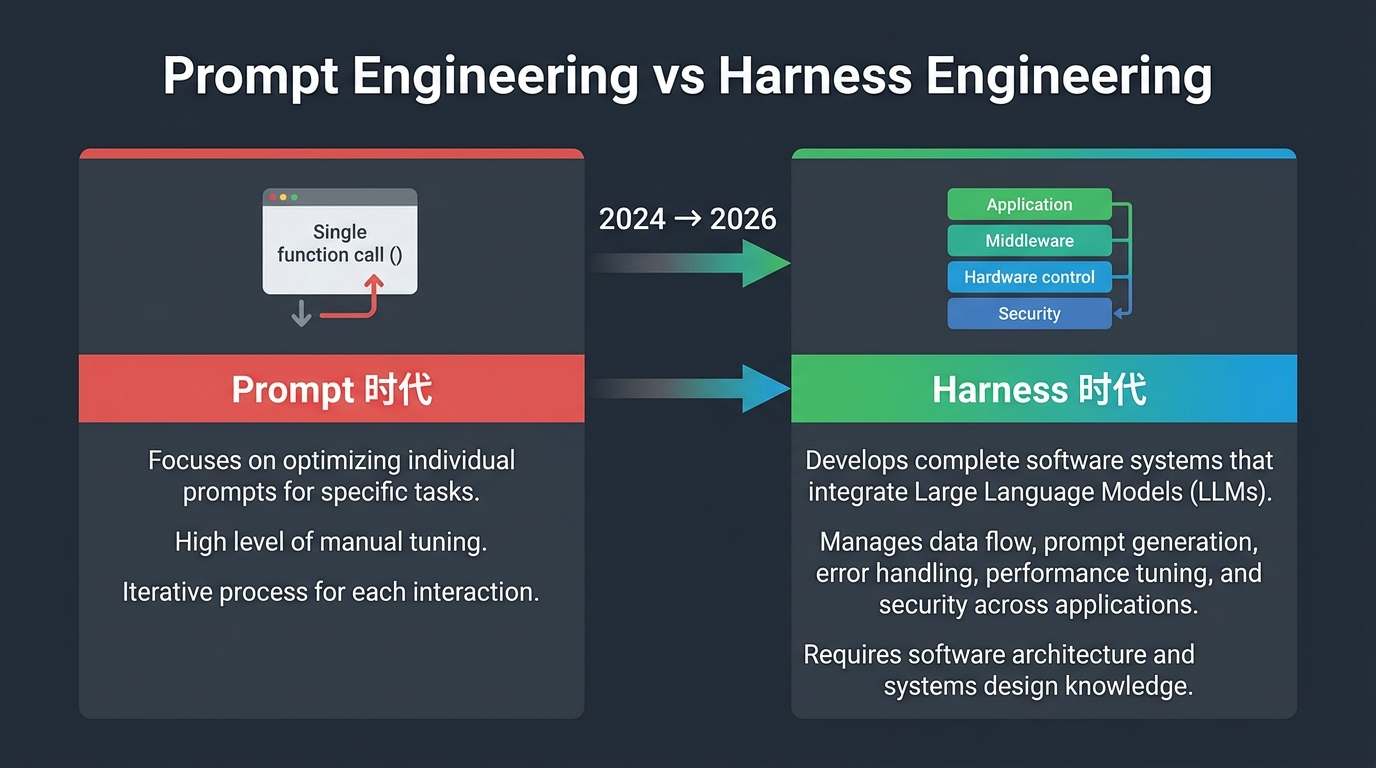
In plain terms: the harness is the agent scaffolding—orchestration, context management, tool integration, permission boundaries, and error recovery—the whole engineering layer that lets a model work reliably.
A software analogy helps:
- A prompt is like a function call. You give it input, it gives you output.
- A harness is like the runtime. It manages memory, scheduling, I/O, exceptions, and resources.
Put differently: the prompt is the API layer; the harness is the operating-system layer.
A complete harness typically contains the following components (a synthesis of several sources, not a definition from any single one):
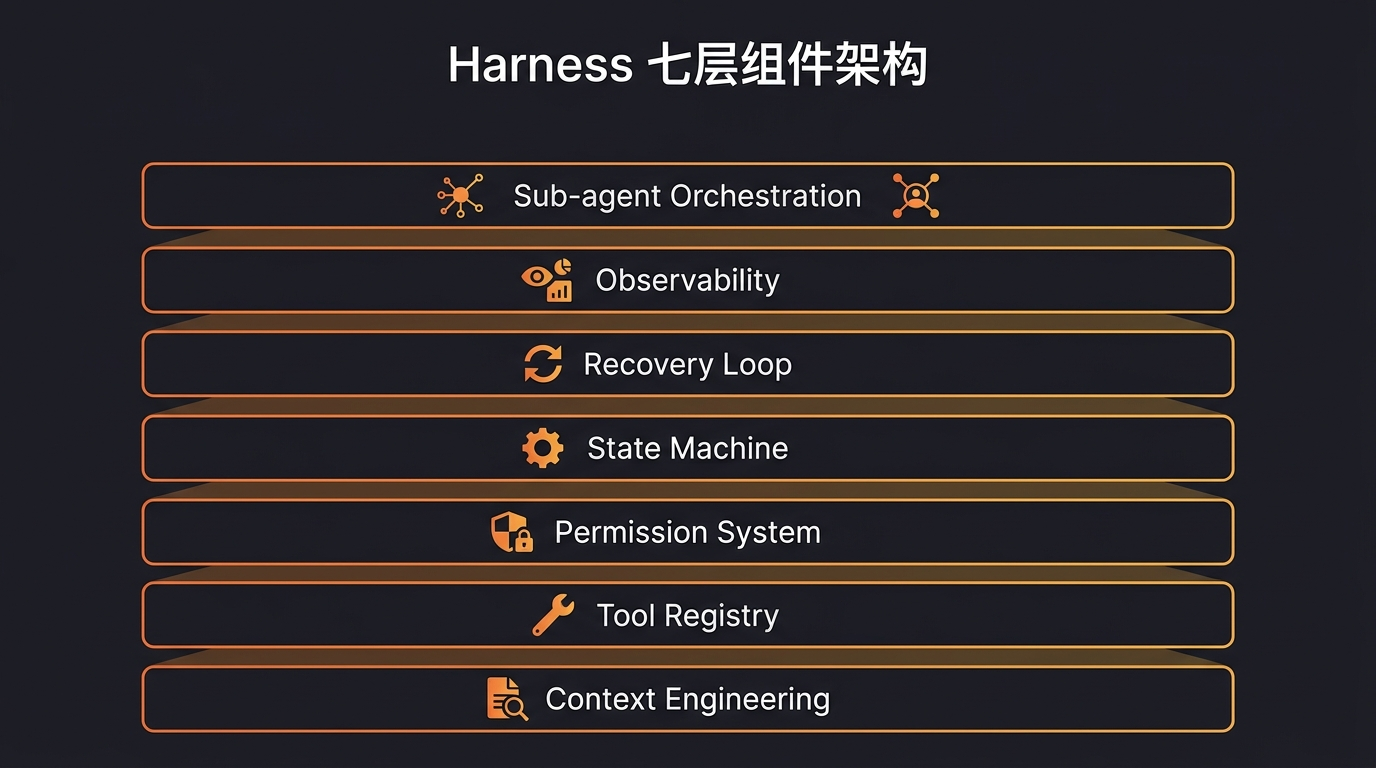
- Context engineering: deciding what files to read when, which history to keep, and in what format
- Tool registry: which tools the agent can call, how it calls them, and how arguments are validated
- Permission system: which actions need user confirmation and which can run automatically
- State machine: the transition logic between waiting, executing, failing, and completing
- Recovery loop: what happens when a tool call fails or the model produces something malformed
- Observability: what happened at each step, how many tokens it cost, and why a decision was made
- Sub-agent orchestration: when to split a task and how to merge the results
Put these layers together and you have a harness. Claude Code and Codex are, at bottom, concrete harness implementations.
Why 2026 is the year
One question remains: why did OpenAI and Anthropic both bet on this word at almost the same moment? Three forces converged in early 2026.
1. Model capability became a commodity
The gap between GPT-5.5, Claude Opus 4.6, and Gemini 3 Pro on hard benchmarks like SWE-Bench shrank from over 30% in 2023 to within 5% in 2026.
Once the model itself stops being the differentiator, the differentiator moves to the harness.
That's why both companies are promoting their harness designs so heavily. They're selling more than a model—they're selling the combined model-plus-harness experience.
2. Enterprise deployment took off
Agent deployments entered production environments starting in 2025, and teams quickly discovered:
- A single runaway token loop can burn $5,000
- An ambiguous instruction can make an agent delete the wrong files
- One failed tool call can send an agent into an infinite loop
These are harness failures, not model failures. Enterprise demand turned Harness Engineering from an optional optimization into a required skill.
3. AHE made the harness measurable
The AHE framework, released in April, pushed the idea further. It can evolve automatically.
In brief: AHE decomposes the harness into its components—system prompt, tool descriptions, sub-agent configuration, memory—tracks each component's contribution through observability, then uses an optimization agent to automatically rewrite the weakest link.
The result: on Terminal-Bench 2, pass@1 rose from 69.7% to 77.0%, beating a hand-written Codex (71.9%), the self-evolving ACE, and Training-Free GRPO.
More notably, a trained harness isn't locked to a model. It transfers to SWE-bench-verified and four other base models and still shows gains. That suggests the harness learned general engineering experience, not an overfit to one benchmark.
AHE turned the harness into something that can be quantified, optimized, and compared. That is the key reason the industry adopted the term so quickly.
What developers should do now
If you're still building agents the 2024 way in 2026, you're likely starting to feel the ceiling. Three shifts are worth making—and the first one alone is enough to start with.
Rethink your project structure
Good harnesses share one trait: the project itself is legible to the agent.
Concretely:
- A README that says what the project is, how to run it, and what the main constraints are
- A CLAUDE.md or AGENTS.md that states the rules an agent should follow in this repository
- Clear responsibility statements for key directories
- Test, build, and deploy scripts that can be invoked independently
Anthropic does exactly this in the Claude Code project. One line in CLAUDE.md beats a 1,000-word system prompt, because the harness reads it at the right moment instead of stuffing everything into context.
Focus on failure modes, not success modes
In the Prompt Engineering era, people spent hours asking, "What prompt will make the model succeed?"
In the Harness Engineering era, the better question is: where does the model fail, and how does the harness recover?
For example:
- What happens when a tool call returns a 500? Retry how many times? Fall back to which tool?
- What if the model's output format is wrong? Fail immediately or try to parse it?
- What if a long task overflows context halfway through? Compress history or split into sub-tasks?
These "what if" designs matter far more than making a prompt slightly more precise.
Treat the harness as an observable object
If your harness has no logs, no metrics, and no traces, it isn't a harness—it's a black box.
At minimum, you should be able to answer:
- How many tokens did this task consume, broken down by step?
- Which tools did the agent call, how many times, and with what success rate?
- Where did it get stuck, and how was it resolved?
- If a user reports a wrong result, can you reconstruct the agent's decision path from logs?
AHE got its harness to 77% largely by quantifying each component's contribution. You don't need to build AHE, but you should at least be able to see what your harness is doing.
The prompt isn't gone—it's a layer
So is the Prompt Engineering era really over, and the Harness Engineering era really beginning?
The more accurate framing: prompts are still part of the harness, but the harness has grown more complex than the prompt itself.
Front-end engineers still write HTML and CSS today, but their work is mostly frameworks, state management, performance, and build tooling. HTML and CSS are the foundation, not the whole job.
Harness is similar. It isn't a replacement for prompts—it's a new layer of AI engineering.
2026 isn't the year harnesses exploded overnight. It's the year they moved from "a few early adopters experimenting" to "an industry consensus forming." OpenAI and Anthropic betting on the same word at the same time is just a footnote to that shift.
If you're just starting with Claude Code or Codex in 2026, spend your time understanding the harness design of the tool you're using, reading its official documentation, and studying its failure modes—rather than endlessly tuning prompts.
That will matter far more than writing another 200-word system prompt.