Word came down that we'd be expected to hand in a written reflection at the end of the training program. The jolt was exactly the one I felt as a kid, when the teacher announced right after the movie that we'd be writing a review of it. Something inside me started galloping.
Every day the group chat for the young cadre class fills up with other people's reflections. When I have a spare moment I download them and read. They're good — genuinely good — and I've learned from them. The trouble is that the more I read, the less able I am to write anything myself. That's what people mean, I suppose, when they say a piece of writing can send the reader into raptures and the writer into a panic.
Still, homework is homework. I'll skip the numbered points and just set down a few loose impressions.
I'd heard about it before, but this was the first time I'd sat in a formal setting and listened to Principal Shen talk about how the ecology of Tianyi High School has changed. The campus has a little bridge over running water, hedges and shade trees, pavilions and terraces — and chickens, ducks, geese, and sheep. These decidedly domestic animals enjoy special privileges; they wander wherever they please. When Tianyi graduates bring the subject up on Zhihu, they write about it with unmistakable pride.
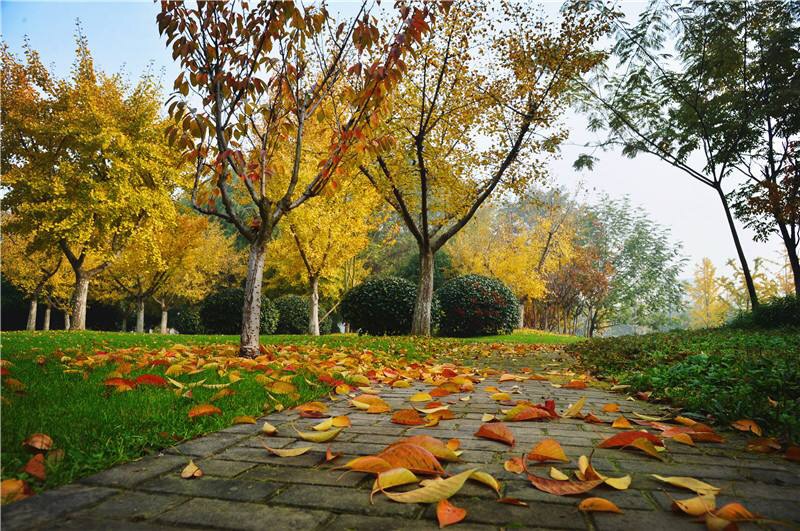
I also remember Quanzhou No. 7 High School, whose decision not to sweep the fallen leaves drew a wave of praise online.
Everything is connected; things rhyme with one another.
We ride bicycles and dream of buying a car; we buy the car and discover everyone else has gone back to bicycles. We eat wild vegetables and dream of delicacies; we get the delicacies and find everyone else has taken up wild vegetables. Our campus is buried in fallen leaves and we dream of spotless, uniform tidiness; we achieve it and learn that other campuses are letting the leaves lie.
What comes next is obvious to everyone: those people aren't riding bicycles, they're riding an environmental ethic; they aren't eating wild vegetables, they're eating health consciousness; their campus isn't covered in leaves, it's covered in ecology.
We always want to be ahead of the trend, and we are chronically a beat behind it. Maybe the thinking needs to change. When the road runs out, you can't simply sit there waiting for willows and blossoms to appear.
Sure, we could go buy a few chickens, ducks, geese and sheep of mixed parentage and turn them loose. But it's worth understanding that those wouldn't just be a few birds and a sheep. They'd be a changed way of thinking. They'd be a sense of scale.
The group discussion topic on the last day of the program happened to overlap with what I'd been chewing on: when all you have is a hammer, every problem starts to look like a nail.
Once a single way of thinking becomes habit, we're liable to apply it to everyone and everything — and that is usually where trouble begins. Someone who has taught for decades, if he keeps treating his family the way he treats his students, will generate a fair amount of friction at home. Here the key word is break, and the only thing to be broken is yourself.
Nothing stands until something is broken. The Book of Changes says as much: change, and you get through; get through, and you last.
A few of the specialists also took some time to talk about the helplessness built into education, so I'll spend a few words on that too.
In his lectures on Dream of the Red Chamber, Jiang Xun points out that we have no idea how the novel was really meant to end. If the author was truly writing out the dream of his own life, he must have felt that all that splendor was a dream. He doesn't care about the ending; he is telling you that in the end everything — power, wealth, love — is an empty thing. And yet inside all that emptiness, your attachment is indispensable.
On the road of education there is a great deal of helplessness. My hope is simply this: what belongs to knowing can stay with knowing, and what belongs to attachment can stay with attachment.
People like to ask: what did you get out of that lecture, that report? It's a hard question to answer. What I can say for certain is that we do make progress each time we listen to a lecture or a report properly. And while reaching the state of "one conversation worth ten years of reading" depends on the speaker, it also asks a good deal of the listener. After all — do you really imagine you can understand a person's one talk without having read the ten years of books?
That's about the sum of it.