The morning meal
From childhood onward, many of us have been told the same thing: eat a good breakfast, eat a full lunch, and eat a light dinner. There is also that old saying about the morning deciding the whole day, so by that logic breakfast seems almost compulsory.
Apparently, in much earlier times, people often ate only two meals a day. Whether that was because food was scarce or because custom simply worked that way is a question better left to historians. My grasp of history has never been reliable enough to make grand claims without inviting laughter from every direction. What is easy enough to see, though, is that three meals a day have now become the standard. We no longer worry quite so much about failing to get enough nutrition, and it has also given people who are “too full with nothing better to do” something to discuss after eating.
With modern science came scientists, biologists, nutritionists, and all manner of experts explaining what breakfast ought to look like. The advice usually comes down to familiar principles: balanced nutrition, sensible energy intake, food that is easy to digest, and so on. These rules are more or less universal, since human bodies are still human bodies and must obey the same basic physiology.
Of course, the principles may be shared, but the execution varies wildly. In the United States, breakfast might mean pancakes, or coffee with fried eggs and toast, perhaps with a few halved tomatoes on the side. In China, someone in the north may eat noodles, while someone in the south may prefer congee and something to go with it. If anyone objects that southerners also eat noodles, then I can only say that there are also people in America who gnaw on pizza in the morning. A short essay cannot possibly cover every exception. A rough picture will have to do.
And if we start talking about breakfast culture across China, there is no end to it. One could fill a hard drive with it and still be nowhere near done. Just the well-known items are already a crowd: sesame flatbread, fried dough sticks, sweet soy milk, congee, wontons, dumplings, rice noodle rolls, jianbing guozi, guoba cai, mianwo, tofu skin, steamed sponge cakes. Then there are all the noodles: hot dry noodles, dan dan noodles, Chongqing-style small noodles, wonton noodles, noodles with gravy, and plenty more.
That is before even mentioning the obscure local things that may not be famous but still have their devoted fans. Somewhere, it seems, people eat plain white tofu for breakfast—nothing added, just soft, pale tofu so delicate it breaks at a touch, somehow scooped onto a strip of bamboo and swallowed with a slurp. It does not taste like much, but some people like precisely that.
The problem of appetite
Morning appetite is often not very cooperative, which only adds discomfort on top of discomfort.
The main issue is that waking up already tends to come with a certain resentment. The first thing after opening one’s eyes is to check the time. If the clock says three or four in the morning, wonderful—there is still room to sleep, unless the reason for waking is a mosquito singing beside your ear and forcing you to deal with the mosquito net, or unless nature is making demands. Otherwise, you can turn over and continue your appointment with the dream world.
But if the time is six, or any other hour when the sun is already preparing to show up, then one falls into the dilemma of whether to sleep or not sleep. That is the true point at which morning irritation begins.
And if the day is not Saturday or Sunday, there are probably classes waiting in the morning. Worse still, it might be an 8 a.m. class. The moment that thought appears, one’s mood naturally drops another notch. People are like that. It cannot be helped.
The canteen situation
I am not sure whether this has anything to do with the overall quality of a school, but the canteen here sits somewhere in the middle: not terrible, not impressive. The food is not exactly hard to swallow, but the choices repeat themselves so often that complaints become inevitable.
In the morning, walking into the canteen, the stalls line up one after another. First there is the place selling wheat-based food, though in practice that means only noodles and dumplings. Then comes the rice noodle roll stall. Farther along is the window selling what I can only call “solid food.” The congee stall does not seem to wake up that early, so the window is present but useless. The milk tea shop at the other end of the canteen is also not open yet, so if one wants a hot coffee to wake up a little, that plan goes nowhere.
So if you happen to be a proper southerner, and you want breakfast that does not feel dry enough to scrape your throat, the options are limited. You either get soup noodles or dumplings, buy some drink or a bottle of cold mineral water from the small shop, or go to the “solid food” window, which also sells fresh soy milk.
The soy milk, however, is almost too fresh. Not undercooked—rather, too freshly cooked, still so hot that you can pay for it but cannot immediately drink it to solve the urgent problem at hand. In that case, the better choice is often to visit the small shop and buy a bottle of ice-cold water. Besides moistening the throat, it has another use: if you are eating noodles, you can pour the cold water straight in and turn the bowl into a kind of chilled noodle situation.
What counts as “solid food”
Someone might ask: solid drinks are powders you mix with water, but what exactly is solid food supposed to mean?
That is the problem. I am not in the food industry, and I do not know the professional term for this category. But the window sells things like these:
- Steamed buns, steamed mantou, and various kinds of mantou, including brown sugar ones, corn ones, and ones with sausages stuffed inside
- Steamed siu mai-like items, including sticky rice versions and the standard kind
- Baked buns, the sort that are golden on the outside and coated with a strange sugary glaze
- Lotus-leaf sticky rice chicken and assorted sticky rice products, sometimes even yellow-braised chicken rice wrapped in oil paper
- Whole boiled eggs and boiled corn, though unfortunately not sweet corn, but yellow waxy corn
- Steamed sponge cakes, in both brown sugar and white sugar versions
In short, it is that whole family of food: things that may or may not fill you up, depending on the day, your stomach, and perhaps fate.
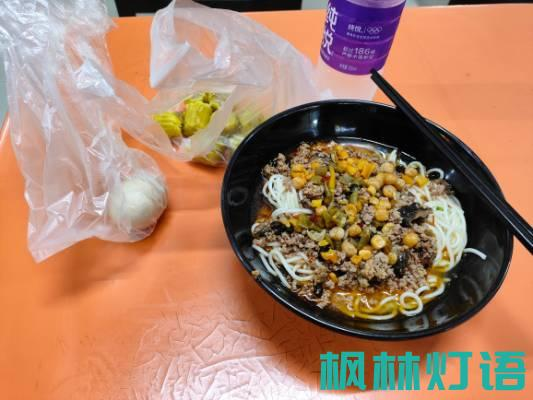
My own habit is to buy one portion of siu mai—eight pieces for five yuan, the yellow things in the picture—and put them into noodles from the neighboring stall. Sometimes the noodles are tossed with peanut sauce; sometimes they are topped with za jiang, not zha jiang, though “minced meat noodles” would probably be a more honest name. If the noodles are too thick, too salty, or too hot, then as mentioned earlier, I simply open a bottle of cold water and pour some in.
Fed is fed
Plainly, none of this is fine dining. No one would mistake these things for rare delicacies. But it is still better to eat something in the morning than to sit through class on an empty stomach.
The real trick may be to keep rotating between options, so that boredom does not arrive too quickly.
Or perhaps I should start the morning by making myself a cup of coffee first.