When a news report says a product contains a harmful substance at 'N times the limit,' the internet quickly turns it into a joke about how we must all be invincible. But standards, like shelf life, come out of quality control, and the central principle of quality control is comparability.
Imagine two apples. You want to know which tastes better, but 'tastes better' cannot serve as a standard because taste varies from person to person. You might instead use sugar content as a proxy: it is standardized, repeatable, and can support a general claim that higher sugar content means better taste. That is the essence of comparability: a result that is unique (reliable) and accepted (valid). The second part is easier to game. The fuss over 'over the limit' often rests there: people trust the number but do not know—and may not really want to know—what exceeding it means.
Health and food standards are usually conservative. A common approach is to take the lowest no-observed-effect level from animal experiments and apply an uncertainty factor, often around 10, when deriving human exposure levels. When chronic toxicity data are missing, the standard may be even more conservative. But this whole approach assumes that contaminants follow a dose-response relationship. That assumption is the interesting part.
Dose and effect are related, but not always through a threshold
Toxicology generally assumes that a substance—a drug or an environmental contaminant—needs a threshold before it produces an effect. Only above that threshold is it considered toxic. For some exogenous substances, however, this assumption is problematic. Edward Calabrese, a professor in Massachusetts, has argued that the traditional threshold model can misclassify effects. His work points to many pollutants showing linear non-threshold, inverted-U, and J-shaped dose-response relationships. In plain terms, low doses may stimulate while high doses inhibit, or toxicity may first fall and then rise. These patterns tend to appear at low concentrations—exactly the range where many environmental pollutants sit. Low dose does not automatically mean safe. DDT, bisphenol A, and dioxins have all been reported to show inverted-U curves.
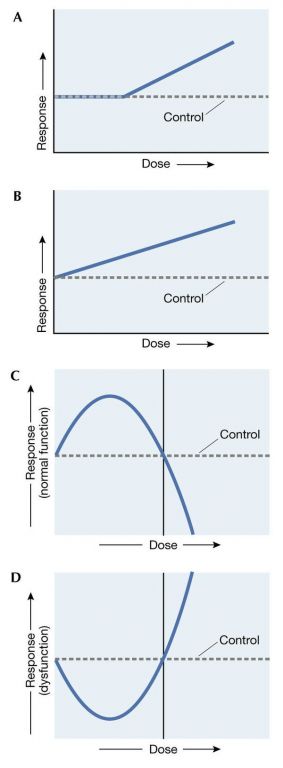
This idea gets relatively little public attention. For one thing, it remains contested within academia. For another, it resembles homeopathy—a pseudoscience that has not yet become popular in China but has a large market—so caution from researchers is understandable. Still, multiple independent laboratories have repeated related experimental results, and the phenomenon appears to be real. Calabrese has called it a revolution in toxicology and argues that most xenobiotics show some degree of hormesis.
The microscopic mechanism is not well explained even for traditional models. Explanations tend to rely on kinetic models and often describe the phenomenon rather than account for it. Once biology enters the picture—even in a cell experiment—uncertainty multiplies, let alone in the complex signaling and feedback systems of a living organism. The chicken-and-egg problem can be set aside for now.
Standards protect, but they are not a complete answer
Back to the 'over the limit' question. A standard is a protective regulation that looks conservative, but it is not necessarily fully reliable. At the same time, without standards, management would fall into chaos. Eventually, it would be ideal to have a device that takes your personal biological information and environmental parameters and produces individualized reference standards for various substances. That would require a thorough understanding of the nature of life.