Once a product manager has gathered requirements from inside the company, from outside sources, and from their own thinking, the next task is not to write everything down and build it all. The requirements need to be decided, shaped into a plan for different stages and releases, and turned into a requirements document for the release that is about to be built.
This sounds heavier than it often is. In many organizations—particularly those running waterfall projects—requirement analysis and decision-making are not separate, drawn-out ceremonies. They happen during product planning itself. The product manager evaluates and decides as part of planning, which keeps other people from sitting idle and keeps the work rhythm aligned. A more formal, separate analysis and decision process tends to appear in larger companies, or when a product has many stakeholders and decision-makers. In most other cases, the product manager makes the call directly.
The three planning considerations and four design principles mentioned earlier are important, but they are not the only tools. The product manager also needs a structured way to look at the incoming pile: classify it, position it, and grade it. That structure makes requirements easier to understand, compare, and turn into an actual plan.
Start by sorting the pile
A product manager will receive plenty of requirements. Classifying and storing them is one of the simplest ways to manage the flow. Think of a supermarket: goods are divided into areas by category, and shelves are arranged by type, which makes it easier for staff and shoppers to find things. Requirements benefit from the same treatment.
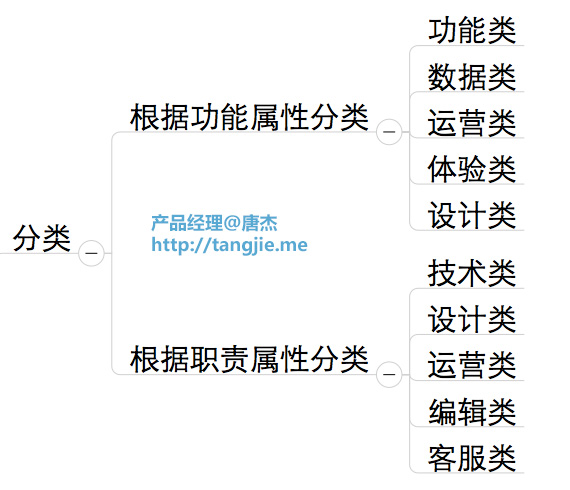
There is no universal classification standard here. The system exists to help the product manager manage, analyze, and decide, so it can reflect personal preference. Requirements can be grouped by function—such as functionality, data, operations, experience, and design. They can be grouped by responsibility—technology, design, operations, editorial, customer service. They can also be grouped by area of the product—home page, section, shopping cart, personal center.
Then judge where each requirement sits
Classification alone does not tell you what to do next. Requirements also need to be positioned. Using the planning considerations and design principles as a guide, evaluate each requirement by importance and urgency. A four-quadrant map makes this visible: urgency on the horizontal axis, importance on the vertical axis.
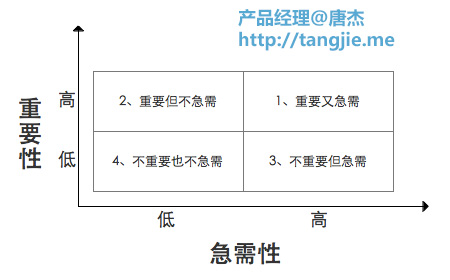
Positioning requirements this way quickly shows what is urgent, what matters most, what can wait, and what should be questioned. It also makes the next step—priority—easier to assess.
Finally, set the order
After sorting and positioning, the product manager needs to grade the requirements: estimate their priority and decide when they will be implemented.
Priority usually comes from three places. The first is the opinion of leadership. The second is the product manager's own judgment. The third is the team's shared willingness—mainly implementation cost and the goals for the current stage.
With classification, positioning, and grading complete, a product manager can move from a messy list to a release plan. Requirements can be divided across planning stages and assigned to multiple versions. If there are only a few requirements, they can be handled in a single iteration. The purpose is not to produce perfect categories, but to keep decisions clear, preserve the product's original strategic direction and positioning, and avoid being pulled away by every new idea that appears.