After I wrote yesterday about the blog system I had AI build on Cloudflare, someone asked whether I planned to open-source it. I don’t. It’s not that I’m guarding some treasure; the program is barely good enough for my own use. Put it in front of other people and it starts to look embarrassing.
That exchange stayed with me because it points to something bigger. Since I started using AI, I’ve become convinced that we’re entering an era of building our own wheels. Not just themes and plugins—the program itself is now within reach for people who like to tinker. I say this mostly because my own path has been one long proof.
Around the new year, when I picked up independent blogging again, I chose Typecho without much hesitation. It still felt like the best fit for me. For a while, my idea of fun was talking with the DeepSeek web version about theme and plugin design, then debugging the results.
Then I came across Hugo and fell for static generation. The problem was that I didn’t like doing everything on a computer, so I used Workbuddy to put together a Typecho-like admin panel. It didn’t take long for dissatisfaction to set in. The external comment system, Waline in particular, never felt fully part of Hugo, and comments always seemed to open a beat too slowly.
So I went back to Typecho, but I couldn’t shake my fondness for static generation. Before long I had AI write a PHP program that generated content statically while calling comments dynamically. I replaced Typecho with it on a Hong Kong host. After repeated revisions, it became stable. Its feature set is still fairly simple, of course—far from suitable for most people.
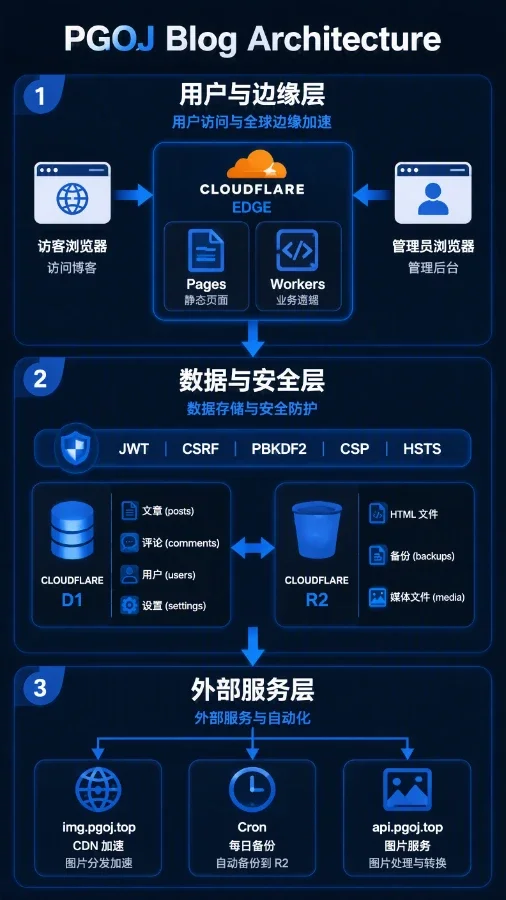
A few days ago, after deciding to give up the Hong Kong host, I had AI imitate that program and build this Cloudflare-hosted system. Articles are generated as static pages; comments, categories, and tags live in D1; media files and backups go in R2. On the whole I’m pleased with it, though it is still being refined.
None of this means everyone should follow the same route. If all you want is a stable, secure place to publish and exchange ideas, mature platforms like WordPress or Typecho are still the obvious choice. But if tinkering is part of the pleasure, and you’d rather have a system shaped around your own preferences, build one sooner rather than later. With AI, writing the program and getting it deployed are not the hard parts anymore. Several AI services offer free credits or free models, which makes this a good moment to experiment. Install a few AI tools, rotate them when fixing and improving things, and you end up busy—and happy.