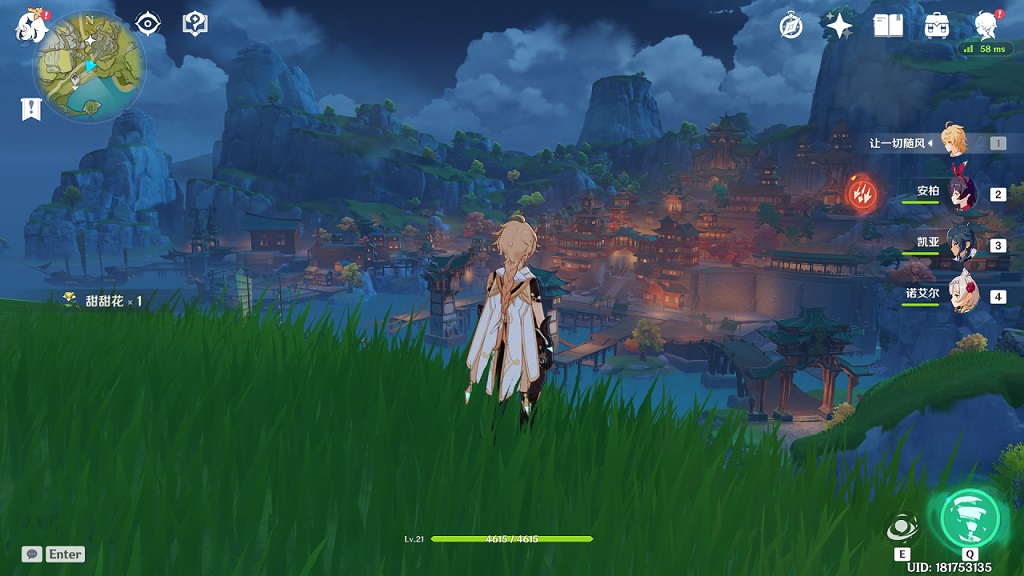
Liyue is one of the nations of Genshin Impact, but it is also the kind of place that can leave a person unsettled in a quiet way. The game has plenty of arguments about what is good and what is bad. Liyue invites something else: a feeling that you have found a patch of ground where the noise of the world can be sorted out.
The Road Through Stone Gate
Stone Gate is the border between Mondstadt and Liyue, and it is where the Liyue story begins. If you travel from Mondstadt to Liyue, there are two trips worth making along the main road. The first is before the Statue of the Seven has been lit. The second is not for a quest but for the sentence “let’s see what is over there.”
Stone Gate does not only divide two nations. It divides two worlds.
Mondstadt leaves a strong impression because it is the starting point. Rewards and routines keep pulling you back to the city. There is a church, a huge statue, and windmills everywhere, all announcing Mondstadt’s particular character. It feels Western, a land with a foreign flavor. That is not a defect; it is the point. Once you leave the city and pass Springvale and Dawn Winery, the mood thins, but NPCs still remind you that this is Mondstadt.
Only after Stone Gate do you step onto Liyue soil. Beyond the gate the road splits. North leads to Qingce Village. South leads through Guili Plains and then to Liyue Harbor. Both are Liyue, but the two directions could hardly feel more different. One is a quiet, peaceful place of retreat. The other is a loud, crowded city.
Liyue’s model is China.
Everyone in Liyue has a story. Many side stories end with a knife twist. Xiao Jiang is one of them. He has an adult body, but his heart still waits for a game of hide-and-seek—even though the other two players, his parents, can never come out to play with him again.
Two stone tablets are his whole world.
It is tempting to ask why people wrap death in so many metaphors. Why not say plainly that someone has died? The answer is not complicated: the feeling of someone never coming back is something no one can easily accept. Xiao Jiang is a virtual character, but when you stand in front of him, the truth is not easy to say either.
Because it is true. They are never coming back.
Qingce Village: Innocence and Stillness
In a local society bound by place, people are born there and die there. Normal life means growing old in one’s hometown. If everyone in a village lives this way, a particular quality appears in human relations: every child is watched growing up by everyone else, and in the child’s eyes the people around have been familiar since childhood. This is a society of familiarity, a society without strangers.
— Fei Xiaotong, From the Soil
From Stone Gate, the road north runs along the water, and at the end of it lies Qingce Village.
Before the village, there are ruins, monsters guarding them, and stones glowing orange. They are a bit of an eyesore. Pretend for a moment that they are not there.
Past that road is a wooden bridge slung between two mountains—Liyue has no shortage of mountains. The bridge is old and pitted. After the first crossing, a large house appears. No one is inside.
When the house is seen at night, it is completely dark. The door will not open. No one stands nearby. Yet weapons have been left by the entrance, as if the owner was here not long ago, or as if the place has not been abandoned.
So where did everyone go?
A house with no people but with supplies still at the door is an unsettling sight. Did the owner leave to trade? Had they stepped out? Had something happened, leaving them unable to return for one more look at the house and the beauty of Qingce? There is no answer.
Two more wooden bridges lead to the center of the village. Ignore the chest that opens only when certain things are lit in order; it is not the reason to be here.
Qingce’s waterwheel turns slowly, and what it turns out is calm, peace, and the ease of rural life. By day the wind is soft and the plants are thick. At night the moon is clear and the stars are scattered across the sky. It is hard not to feel that Qingce is familiar.
It is home.
Qingce Village feels like the clean ground kept somewhere inside a person. It may not exist in reality, but it runs in the blood.
It is also a miniature of Chinese society. For centuries, China has looked something like this: splendor as an ornament, village life as the base. Behind the bustle, there is usually a long stretch of quiet.
For anyone who has spent time in a small county town or returned to a hometown, the smell is immediate. This is village life: quiet, plain, and yet every household has its own story.
Listening to people’s stories means touching one’s own heart. Not all of them are as sharp as Xiao Jiang’s. Many are about anger and joy, grief and pleasure, oil, salt, firewood, and rice. They describe ordinary days and the ways people respond when ordinary days are broken. If you listen to enough of them, a pattern emerges: most of the stories mention parting.
- Dongdong’s father has gone to the Crux Fleet, and Dongdong is waiting for him to return.
- A’you’s parents are working away from home.
- Uncle Kai’s tea stall has no young people left to help him.
- The person who promised Granny Ruoxin they would retire to the countryside together went off to adventure and never came back.
Stories like these have played out in every corner of China for centuries.
Qingce is small—small enough to hold only one word: hometown.
The daytime and nighttime music of Qingce are different, but two melodies share the same shape.
The night theme is called A Village No Longer Young.
It is a title with poetry in it. One comment under the song describes it as a piece that folds together homesickness and the emptiness of a quiet, empty place, time passing and feelings that do not change, loss and waiting. The village is no longer young. Time has worn away Qingce’s liveliness and left only quiet.
The quiet is not something you can carry away.
Guili Plains: Smoke and Fire Among Broken Walls
The game describes Guili Plains as a settlement in ruins outside Liyue Harbor, where one can still sense its former prosperity. After many upheavals, the place has long been deserted, with only broken walls left to keep watch.
That is exactly why it is tempting to avoid going there. Broken walls can stir up feelings too easily.
Eventually, on the way to Liyue Harbor, the road passes through it.
Guili Plains is not as lonely as it looks. Perhaps because Liyue Harbor lies to the south, Millelith soldiers are stationed throughout the area. They bring a trace of human presence to the quiet.
Farther in, the plains are no longer prosperous, but as in Qingce, some people still live there.
One of them is Boss Zhu of Cuifeng Court.
Cuifeng Court sits in something like the outskirts of the outskirts of the outskirts of the city. Standing near Boss Zhu, you can hear him sighing over why he ever opened an inn there.
Give him a Sweet Madame, and though his expression is not visible, the text makes clear that he is delighted.
At first his sigh might be about how hard it is to make money there. That is uncertain. But another reason is certain: there is too little human warmth. Cuifeng Court opens and closes on the same few familiar faces. No outsiders bring new voices or news. Even travelers passing through may not have time to stop. The people on this road are likely heading to Liyue Harbor to trade—there is a sign telling southbound travelers to organize their luggage and unload goods for Millelith inspection—and each has their own goal and business. They will not stop halfway.
That detail gives Cuifeng Court a touch of loneliness.
The setting says Guili Plains was once prosperous and only became deserted after many changes.
Perhaps, centuries ago, Guili Plains could stand beside what Liyue Harbor is today.
What disturbed it? Again, there is no answer.
Liyue Harbor: Prosperity Has Its Own Hard Sutras
Liyue Harbor is prosperous. There is no doubt about that.
Under a deep blue night sky, the harbor is bright with lights. Ships come and go. Voices rise and fall. There are vendors, crowds, a bookshop, a bank—the Northland Bank—an antique shop, and the not-entirely-proper Chunxiang Kiln. It is a world full of life.
What is less easy to notice is that behind the prosperity there is also a faint strain of dissatisfaction.
The feeling is what makes it real. No world is perfect. Liyue’s model, as said above, is China. In the real world, a country that has crossed a thousand years of time is naturally not perfect in every corner. People have sorrow, joy, parting, and reunion; the moon waxes and wanes. Such details do not ruin the beauty. They pluck at something in the heart.
Liyue Harbor has many NPCs, and many of them will talk. During a long walk through the harbor, it is worth speaking to everyone who will answer, just to see what comes out.
Remember the stories from Qingce? Some people in Liyue Harbor are closely tied to people in Qingce—as parent and child, brothers, or lovers. The correspondence is well placed. Anyone who has visited both places and spoken to the NPCs will feel it: Liyue Harbor and Qingce Village are separated by geography but connected in spirit.
In Liyue Harbor there is a place called Wangsheng Funeral Parlor. If you tell the ferryman at the door that you are “something else,” she answers:
...I see.
I am one who faces death on behalf of others.
I have no tie to all that you were when you came.
I have no tie to all that you will be when you go.
Wanderer, please leave.
Wangsheng is the last stop on life’s journey. When the night watchers realize they are speaking to “something else,” they do more than ask it to leave. There is also awe and respect for death. They have watched the end of a person’s prosperity. They are among those best able to understand the loneliness and sorrow that repeat day after day. And that is often what moves people most.
Even setting aside Wangsheng’s work and the taboos around it, the words are worth turning over: why call the other person a wanderer?
Perhaps because that is the most general picture of a human life. We come from wandering and go back into wandering. We do not know why we come, and we do not know why we go.
What Liyue Leaves Behind
There are too many feelings in Liyue to put into one essay, and too many of them resist clumsy description. That is as it should be. Real feeling is understood most deeply when it has been lived through.
Everything in Liyue is worth looking at closely. If you slow down, if you walk the road a second time not for a quest but for the place itself, Liyue may leave you with something that stays.