Last weekend, after finishing a scheduled piece about discrimination against men, I wrote a short note about how I had been taking the idea of news apart. Part of that is biographical: my first job was connected to the newspaper business. Part of it is what I watched happen: print declined, the news business lost ground, and reporting shifted from asking what is true toward asking which side a story belongs to. That shift does not break anything overnight. It works like a slow poison. One day, perhaps, we will accept the loss of truth-seeking, independent thought, even the ability to document the world in our own way as calmly as we have accepted AI. I fear that day, and I fear it for myself more than for society.
Last month I had saved a note about a small online argument. It started at WWDC. Munechika Nishida, a reporter and freelance writer, was in the media area at Apple Park. He complained on X that a 360-degree camera held in front of him ruined his experience of covering the event.
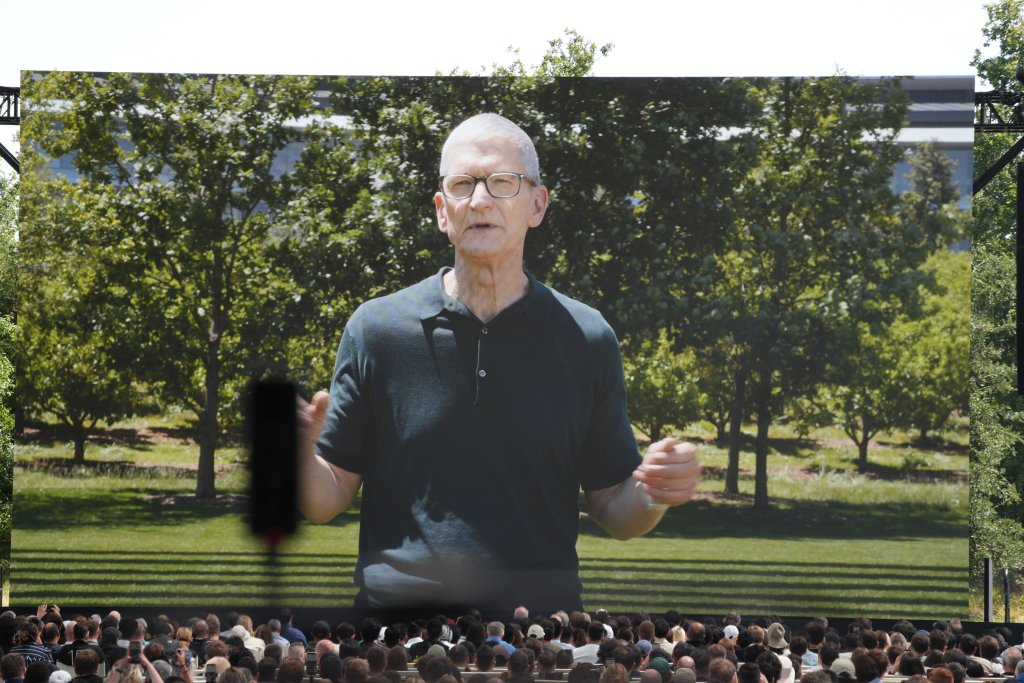
More people joined the complaint. At first I assumed it was another fight between professional media and independent creators. Then people found the owner of the camera: Justin Ryan. He had been promoting footage shot with the same 360-degree camera.
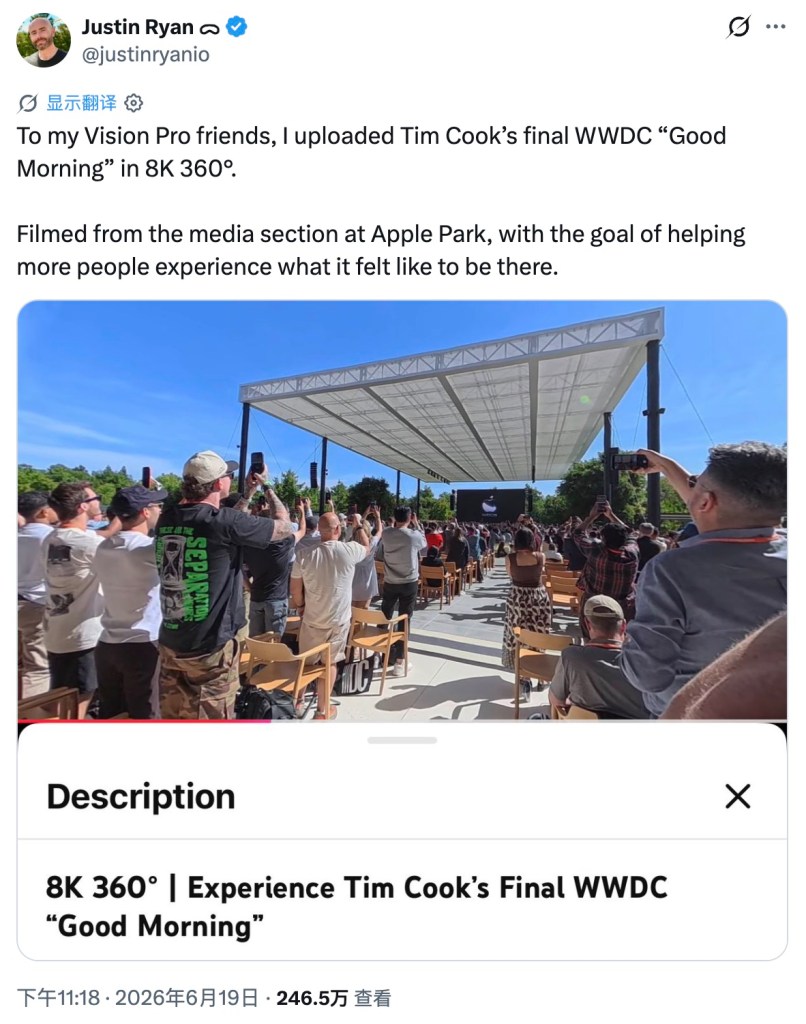
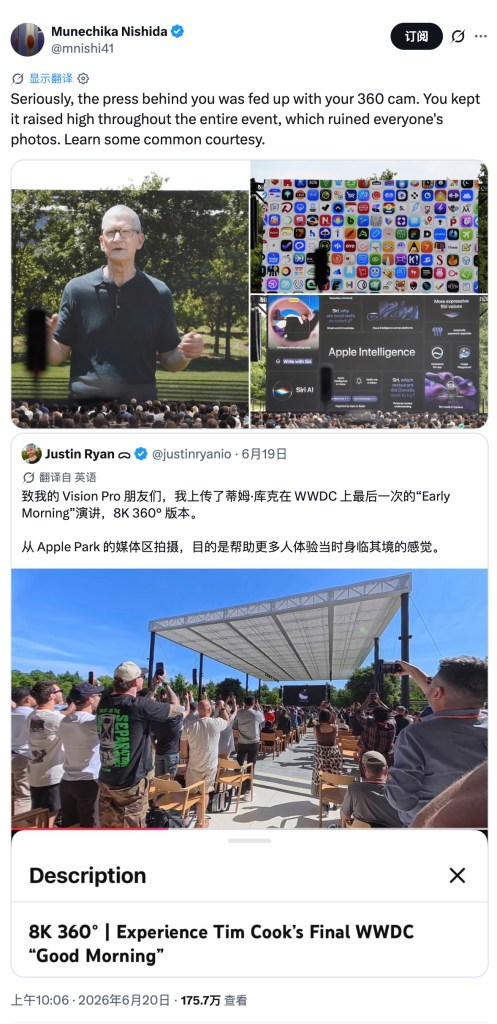
His plan was to live-stream a 360-degree view for Vision Pro users on YouTube, with the footage coming from the media area at Apple Park. Nishida confronted him directly. In Japanese, he said, roughly, that the press behind Ryan had all had their photographs spoiled by the camera, and asked him not to hold it up for the whole event. The interview opportunity, he pointed out, was not Ryan’s alone. He added in English: “Seriously, the press behind you was fed up with your 360 cam. You kept it raised high throughout the entire event, which ruined everyone’s photos. Learn some common courtesy.”
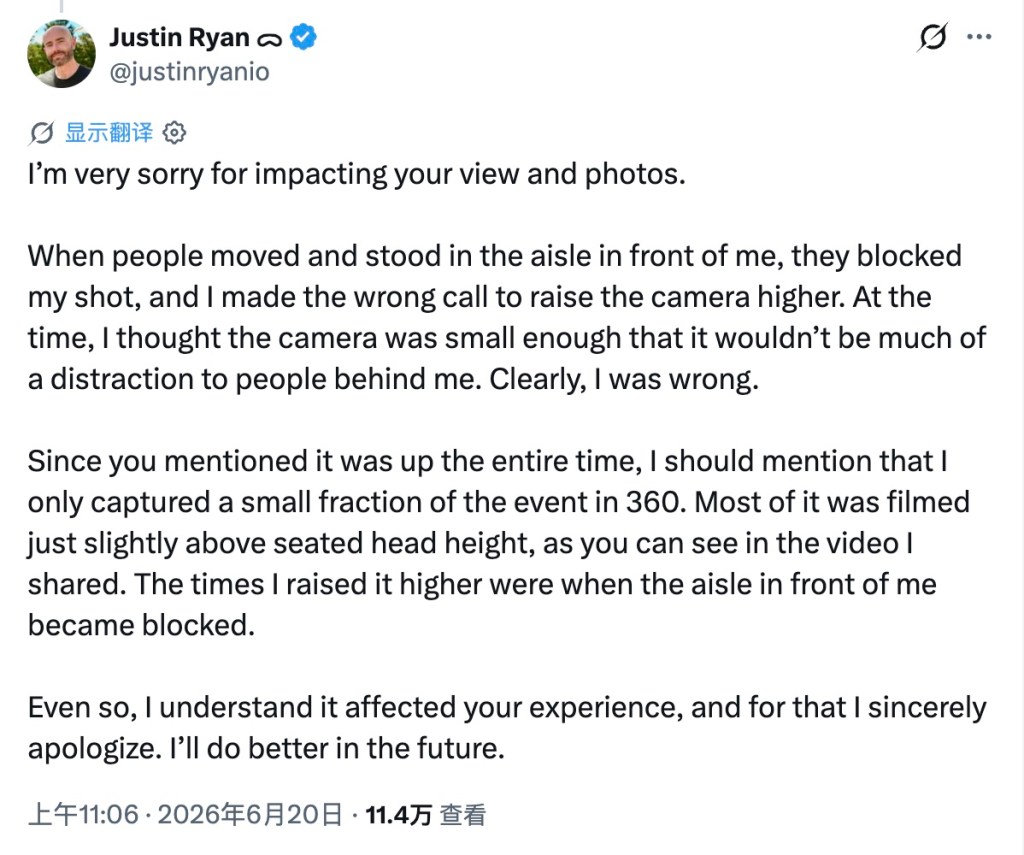
Ryan apologised. He said his own shot had been blocked by other people; he had assumed his camera was small enough not to affect the people behind him, so he raised it. He also insisted he had not held it up the entire time.
When I first saw the exchange, I thought the discussion would stay on photography etiquette, or on the boundary between reporters and creators. Then I kept reading the replies. People were not really discussing the same thing at all.
Some called Justin a scourge. Some reminded him that no apologies are owed to internet trolls, ever. Others took the reasonable route and pointed out flaws in the victims’ case: maybe the camera did ruin shots, but the only ruined shots were photographs no one would cherish of a giant screen showing a pre-recorded video that already existed online. All of these were recognisable positions. Then I found a comment that had almost nothing to do with the original incident, and I liked it more than anything else in the thread: “Every single person recording with their phones looks like a fucking cult.”
I stared at that line for a while. It did not support Justin. It did not support the traditional press. It suddenly turned everyone into an object of observation. What interested me was not who blocked whom. It was why the same event could become so many completely different pieces of news.
This is where perspective and stance separate. Perspective is the part of the news that a person sees. One person sees the event through Justin’s 360-degree camera. Another sees it through the lenses of other media. In some of those views, the 360-degree camera itself blocks the view. A new piece of news is born: new-media workers are destroying traditional media. Stance is something else. It is the point in the story where people find their own identification. Some viewers saw Cook say “Early Morning” one last time. Some saw media people selfishly sacrificing other people’s experience for traffic. Some picked sides between the people in the argument. Some, like me, made the media itself the main character.
In recent years, news seems to move very quickly from “what happened?” to “which side are you on?” But does perspective really equal stance? News writers cannot fully escape subjectivity. I would break it down like this:
<table> <thead> <tr> <th>Level</th> <th>Question</th> <th>Subjectivity</th> </tr> </thead> <tbody> <tr> <td>Fact</td> <td>What happened?</td> <td>In theory, verifiable</td> </tr> <tr> <td>Perspective</td> <td>What did I see?</td> <td>Inevitably narrow</td> </tr> <tr> <td>Frame</td> <td>What do I think is worth seeing?</td> <td>Very hard to avoid</td> </tr> <tr> <td>Stance</td> <td>How do I want readers to understand it?</td> <td>Cannot be hidden</td> </tr> </tbody> </table>Take Fang Fang. Between January and March 2020, the Chinese writer used a personal perspective to write on Sina Weibo about the outbreak and spread of COVID-19 in Wuhan. Because it was written as a diary and dealt with a sensitive subject, it later caused controversy. Broken down by subjectivity:
<table> <thead> <tr> <th>Level</th> <th>Content</th> <th>Subjectivity</th> </tr> </thead> <tbody> <tr> <td>Fact</td> <td>An outbreak happened in Wuhan</td> <td>Information lockdown and opacity made timely verification difficult</td> </tr> <tr> <td>Perspective</td> <td>As a Wuhan resident, the author saw certain things and heard things circulating</td> <td>Unavoidable, and verification would take time</td> </tr> <tr> <td>Frame</td> <td>The author chose to record fear, confusion, and disorder</td> <td>Highly likely to stir group emotion and resonance</td> </tr> <tr> <td>Stance</td> <td>These phenomena deserved to be seen and criticised</td> <td>This is how her stance was judged</td> </tr> </tbody> </table>As a matter of perspective, Fang Fang offered a Wuhan seen from where she stood. It was not an absolutely objective record, because perspective itself can hardly be absolutely objective. Some people said she provided a different voice. Critics said the diary contained too much hearsay and did not objectively reflect what the outbreak was really like. Soon people were questioning her stance. Her response also attacked the stance of her critics, calling them ultra-left and accusing them of labeling. In the end, the affair turned into a witch hunt at the level of stance, aimed at Fang Fang and the scholars who supported her.
A piece I wrote recently made a similar wager. I offered an observation: men are also discriminated against. Does that perspective necessarily mean I support men over women, or that I deny the reality of discrimination against women? Separately, it is easy to see the difference. But what happens if stance becomes the first criterion for deciding whether a piece of news is right or wrong?
Stance has no right or wrong, which would mean perspective has no right or wrong either. In practice, however, stance is easily sorted into right and wrong, because stances conflict. A while ago, during a Brazil-Japan match, many people in bars cheered for Japan. Many had grown up watching anime, including Captain Tsubasa. They also felt that Japan represented Asia at the World Cup, and as neighbours they wanted to show support. Then the Shanghai Football Association published a civilised spectating initiative for World Cup matches. Two of its more interesting points said that people should always cultivate homeland sentiment and oppose irrational side-taking fanatic cheering. People connected the two events and put the label of bad influence on fans who cheered for Japan. The Japan fans were not meek about it. They shot back, more or less: you fucking qualify for the World Cup first.
There is no inherent right or wrong in which team you like at a World Cup. But teams meet, and matches produce winners and losers. People who tie their dignity to a team care especially about winning and losing, and about face. Taking sides becomes the most direct move in the game of stance. Someone who dislikes Japan, or whose team was beaten by Japan, can look at Japan and its fans from any number of perspectives. Stance becomes the easiest thing to use against them. “You support Japan so much. Are you unpatriotic?” There it is. And with the stance, the perspective is also denied. “You speak for Japan. Are you a traitor too?”
Can news escape stance? Obviously news was not destroyed by stance, and it cannot escape stance anyway. News has carried stance from the beginning. That is part of how it attracts audiences who share a stance. But beneath stance, truth was once something worth pursuing. What has changed is that people now treat stance as more important than everything else, more important than truth, perspective, or frame. The 360-degree camera in front of other reporters is a perfect example. People stopped discussing the event itself. They discussed new-media workers destroying traditional media, and then used stance to punish the person who was recording the news. The event disappeared. What replaced it was a trial of everyone’s identity.
Writing this, I begin to wonder whether news changed, or whether I have become less able to accept what news has always been. Maybe news has always worked this way. And I am doing the same thing: by asking who is ruining journalism, I have taken a stance too. That is the most paradoxical part of discussing journalism. When we try to defend the idea that truth should come before stance, truth first has already become a stance.