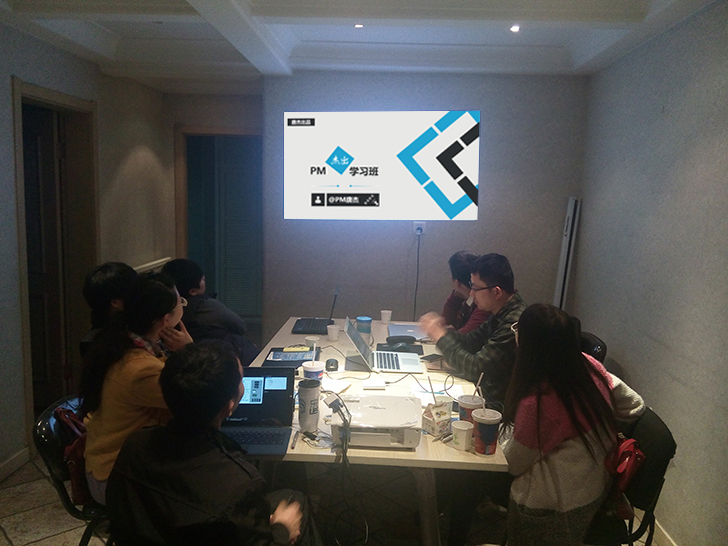
The idea for this workshop started very casually. A friend came to me with a few questions, and somewhere in that conversation the concept took shape. She also became the first person to sign up.
That same night, at 10:30 p.m., I posted a short announcement through my public account. Within half an hour, six people had already said they wanted to join. Since it was late, I did not have time to confirm everything properly, so I did not lock in the final number right away. By the next morning, people had started paying one after another. One person, however, never followed up, so I assumed he had changed his mind. I then shared the news again through my blog and Weibo, and gave the last seat to a female applicant. Later, after all seats were filled, that earlier applicant got back in touch. Because he had originally contacted me the day before, I kept his place. So the workshop that was supposed to be capped at six people ended up with seven.
At first I had jokingly called it the “Kidney 6 Workshop,” but that sounded far too informal. I eventually renamed it the “Outstanding PM Workshop,” which felt much more appropriate.
The workshop has now wrapped up smoothly, and I am genuinely grateful for the support. I believe everyone involved gained something from it, not just the attendees. From my side as the organizer and instructor, the experience also led to a number of reflections that are worth sharing.
I have always liked trying new things first. Whether it is a new technology, a piece of software, an API, a cloud service, or any kind of product, I usually want hands-on experience as early as possible. I have tried buying a MacBook Air through internet finance, and I have also used a CPS model to buy a Surface Pro 3. This time, I even experimented with using a training program to fund an iPhone 6.
These experiences may not look directly related to product management at first glance, but they matter more than people think. By personally experiencing different technologies, products, and services, you start to understand different business models. And once you understand those models, your product thinking becomes broader.
Over the two days of training, I was not only passing knowledge on to others. I was also learning from the work, perspectives, and experience of the people in the room. After the workshop, I found myself with a new set of thoughts and a new way of organizing what I know.
I am not especially strong at math, but I have always enjoyed logic. I like taking a formula, changing the variables, and seeing how the outcome shifts. For a long time, I believed the knowledge structure of a product manager more or less looked like the framework I had already laid out in my book on becoming an outstanding product manager. But this workshop made me realize that the same body of knowledge can be reorganized from a completely different angle—and that once you change the angle, new gaps immediately appear.
This time, I structured the training around the workflow itself: how an idea is generated, how it gets analyzed, how planning happens, how design follows, how implementation is carried out, and how iteration continues afterward. Once I used that process as the main framework, I suddenly saw that many important pieces had been missing from the structure I had relied on before. That realization gave me a new understanding of product thinking.
For example, I had not broken down market analysis in enough detail before. I had not clearly defined certain parts of the work itself. I had also failed to explain enough of the logic behind key knowledge points, along with the supporting cases that make those ideas easier to understand.
Some of those missing pieces are difficult to express through text alone. Others were missing simply because my previous logical model did not account for them. But once I switched to a different framework, the omissions became obvious. If I had not changed the way I organized and thought through the material, I might never have noticed them. It is much like drawing a feature flowchart: when I was preparing the workshop slides, I followed this new logic step by step, and along the way, the missing content revealed itself naturally.
That was probably my biggest takeaway from the entire experience. I had originally hoped that my earlier work could help new product managers solve some of their confusion about entering the profession. But after teaching this workshop, I realized that my own knowledge is still evolving. The structure I used in the workshop slides feels closer to the right process than what I had before. Of course, there may be even better ways in the future. The more you learn, the more you realize the learning never really stops.
Overall, from a purely personal and non-commercial perspective, I consider this a successful round of knowledge sharing, and I am deeply thankful for everyone who showed up and participated.
There was another thing I noticed as well: more and more senior leaders are beginning to pay attention to products, and to the role of the product manager. In both my video courses and in-person sessions, I have seen directors, vice presidents, and company owners join as students. I believe this trend could significantly improve the long-standing problem of unclear and chaotic product manager responsibilities.
Whether management learns about product management through my courses or through other channels does not matter that much. What matters is that the awareness now exists. And for product managers, that is an extremely encouraging development.
I still have more to share after this workshop. Two topics I am currently planning are: one on the messy state of the PM training market and how to choose a course wisely, and another on how product managers at different stages should approach learning differently.
For now, I simply want to say thank you again for all the support.