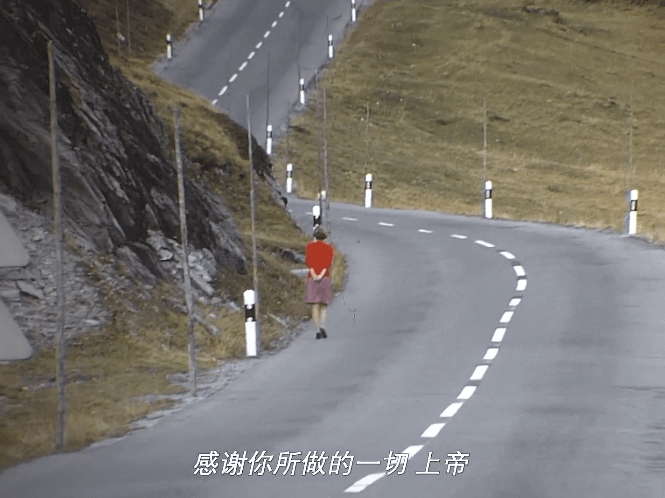
This is the kind of film that resembles a prose diary more than a conventional movie, something that asks to be approached slowly and with patience.
There is almost too much to say about it, which makes it hard to know where to begin. In many ways, it barely registers as a normal viewing experience at all. It feels closer to reading than watching, and that alone makes it a demanding work.
The film plays like an experiment. It abandons the usual cooperation between image, sound, and dialogue. The visual element is reduced to an extreme degree, so much so that the weakening of the image feels deliberate. Sound comes and goes. What remains with force is text.
Those subtitles are drawn from the diaries of a woman named Vivian Barrett, while the images were filmed in postwar Europe, a landscape still marked everywhere by the damage of the Second World War.
Vivian and her husband belong to the European middle class after the war, an ordinary married couple on the surface. Her husband, a pilot, loses the ability to fly after an accident. She decides to develop a new medicine and sell it in the United States. At the same time, their marriage is slowly falling apart. Vivian is unmistakably lonely, and both husband and wife have affairs.
Much of Vivian's writing borrows from the poems of Paravadin. The language is delicate and exposed, full of philosophical reflection and poetic description. That sensitivity gives the film its real weight. The text does not merely explain what we see; it becomes the emotional and intellectual core of the entire work.
There are many striking stories scattered through the film, but one in particular stays with me. Vivian writes about an old man who died on Molokai, even though he had never seen the sea in his whole life, despite living on an island of only about 600 square kilometers. In her diary, she writes: “We all live on Molokai, surrounded by a sea we have never seen.”
That single line seems to open up the whole film. It is about confinement, blindness, distance, and the strange limits of a life, even when the world is right there around us.
The film's overall structure is, in fact, arranged with great precision. But while watching, I did not notice any obvious sign of design or construction. It felt unforced, almost like drifting through a private notebook. Only in the final seconds, when the closing subtitle appears, does everything suddenly come into focus.
Yes, that is when it names its own theme.