I had meant to write about something else, but with the year drawing to a close and a few post-holiday matters already waiting in the distance, it feels better to write about something lighter. Not light in the sense of fireworks, lanterns, crowds, and the grand New Year atmosphere people often imagine, though. For someone who grew up in Guangdong, the so-called festive flavor of the season has never been as thick as the textbooks, essays, and television programs made it seem.
That does not mean the New Year never felt like the New Year. It only means that a small mountain village has its own way of keeping it.
The trouble with having nothing to write
I have not written this sort of casual life note in a long time, mostly because I always feel there is nothing worth writing down. But life is often exactly like that. Not every day produces an incident with a beginning, a turn, and a proper ending.
This reminds me of the diary assignments from primary school. During long holidays, teachers loved assigning diaries: ten entries for summer vacation, for instance. At that age I had neither the habit of observing daily life nor the vocabulary to dress it up. In second or third grade, adjectives and metaphors were still basically foreign objects, so the finished product often became a plain account of movements:
Today I went to the amusement park with my mother. First we rode the roller coaster, then we rode the merry-go-round. After we came out, my mother bought me a sausage. The sausage was very tasty. Then we went home.
At that point I would bite the end of my pen and get stuck, because, well, we had already gone home. The story had clearly ended. But the word-count line in the exercise book was still just out of reach, so there was no choice but to add another sentence:
After we got home, my mother said to me, you should write this down properly. I nodded. So I opened my diary and wrote it down.
There was, of course, one other important problem: within a radius of fifty kilometers of where I lived, there was no amusement park at all.
The New Year I first imagined
My earliest idea of what the New Year should be probably did not come from my own primary-school years. Still, primary school is a convenient place to start.
There was once a passage in a Chinese textbook, I no longer remember which grade, placed in a unit about the Lunar New Year. What stayed with me was a scene roughly like this: sesame stalks scattered across the courtyard on New Year’s Eve, crunching underfoot; palace lanterns, gauze lanterns, ox-horn lanterns all brought out; children allowed to carry little paper lanterns; the temporary lifting of certain restrictions; food prepared in great quantities, then eaten again and again until it almost became leftovers by default; mixed sweets with dust and sand in them; freezing weather, closed shops, and the uneven clang of gongs and drums rising here and there.
The writing was by Liang Shiqiu, from Dreams of Huai Garden, specifically the piece whose title contains the line about a tired horse longing for old fodder and a caged bird longing for its former nest. In my rather thin childhood reading history, that kind of language usually belonged to one of two writers: Wang Zengqi or Liang Shiqiu. So I remembered it.
The textbook version, naturally, had been edited. Certain parts about festive gambling would not have been placed in front of young seedlings. Still, it is interesting that in many places, both then and now, the New Year has allowed a small gray zone for low-stakes entertainment. Perhaps it comes from an agricultural society’s old rhythm: after a whole year of labor, people gather at year’s end for a few rounds. If you win, it is good fortune entering the house; if you lose, it is money spent to ward off disaster. The most obvious modern example is mahjong during the holiday. Wang Zengqi also wrote of Lantern Festival gambling stalls where the dice lay quietly in a bowl because the year was almost over, people had lost about as much as they had planned to lose, and work waited the next day.
As a child, reading such scenes made the New Year feel lively before I had even seen anything like it. If I had to turn that impression into an image, it would be a place full of people coming and going, the smell of fireworks in the air, firecracker cracks in the distance, children shouting, and a red glow everywhere. Not the harsh red of a horror game, but a reddish yellow, like incandescent light or an oil lamp placed behind red glass. That kind of light is not flat. When children are moving through it, it becomes warm and peaceful.
And then there was the food. What exactly were those mixed sweets? I did not know, which made me want to try them. Even if the passage said there might be dust and grit mixed in, curiosity toward things one has never tasted is powerful. I thought I could simply blow on them first and eat carefully. Another text mentioned jiangmi candy. I knew jiangmi meant glutinous rice because the footnote said so, but I had no idea what jiangmi candy was. While the teacher was lecturing at the front, I would secretly flip pages below the desk, trying to find out what sort of thing it could be.
Before that textbook, my idea of the New Year had also been shaped by an old collection of excellent middle-school compositions kept in my ancestral home.
The old house has always felt like a time capsule to me. My father and aunt grew up there, so some of their primary and middle-school books were left behind. Most disappeared over the years—thrown out after terms ended, damaged, misplaced, or simply gone—but a few survived. Among them was that composition anthology, and by coincidence it contained an essay about the New Year.
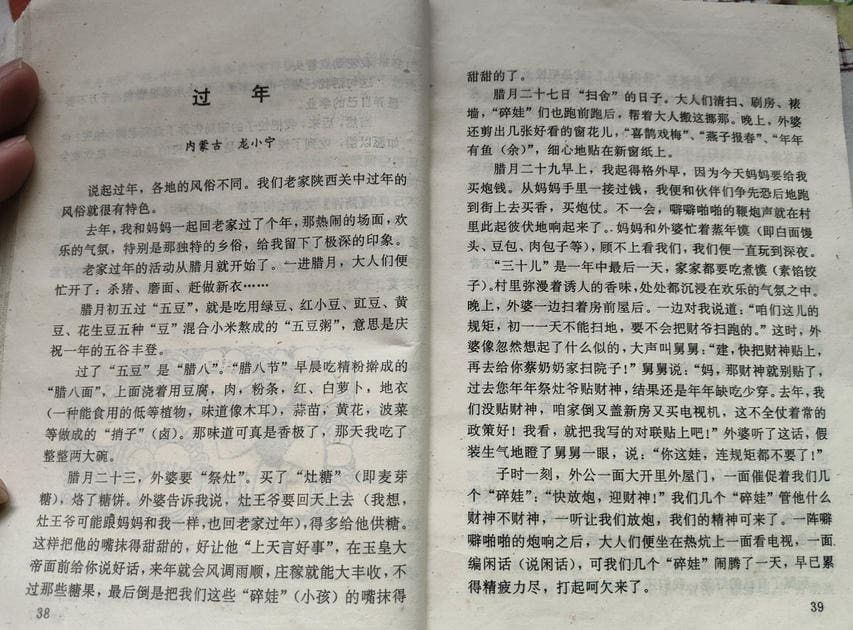
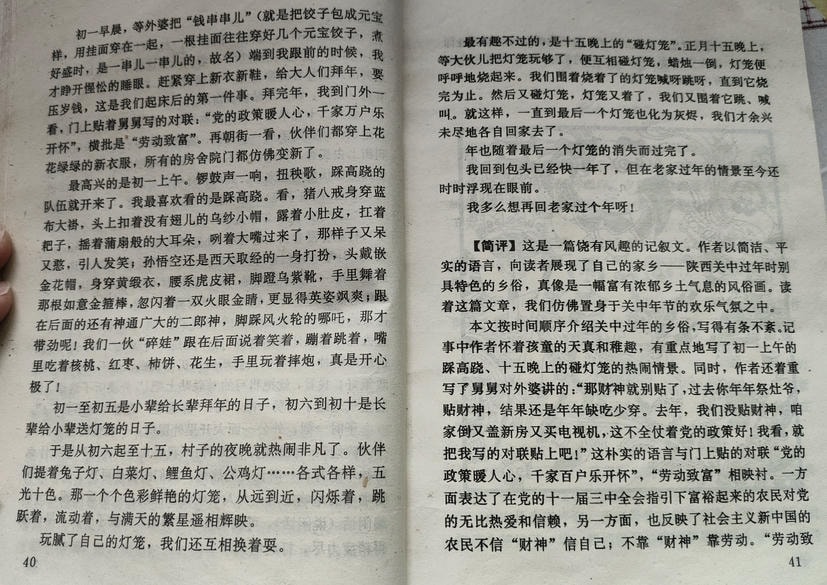
Judging from its content, the essay could not have been written before 1978, and it was certainly no later than 2000. The book was probably from the 1980s or 1990s, but its cover was gone, so there is no easy way to verify it. One might think the customs of Guanzhong in Shaanxi would have little effect on a child in Guangdong. But when I was small, the village had no internet. During winter and summer stays back home, entertainment meant watching television and reading whatever old books were lying around.
Add to that an obvious fact: most days of the year are not New Year’s days. So these written images arrived first and occupied the space. I came to assume that the New Year was more or less supposed to look like that.
The village was never that noisy
Even now, if someone says Lunar New Year to me, my mind may first jump to the fifth day of the twelfth lunar month and its five-bean porridge, or to Laba noodles on the eighth day, which seem to be a Guanzhong custom. Then come sugar cakes and vegetarian dumplings. But today, food can be eaten almost whenever one wants. If there is no ready-made version nearby, there will always be tutorials teaching you how to make it yourself.
What makes me feel that something is missing is not food. It is that the New Year in my home village was never as bustling as the New Year in those essays.
The village is still geographically in Guangdong, but it sits in a fairly remote mountain area. After leaving the main road, one must twist and turn along smaller roads for an unknown number of kilometers, pass several hills, find a narrow path near a large threshing ground, and then continue inward a few hundred meters. Such inconvenient transport has two direct results: young people leave to work elsewhere, and there is no real center where people gather.
In the traditional sense, the New Year is supposed to be a festival of reunion, and reunion should be lively. But once this landscape is added, things become more subtle.
First, young people work outside. The unspoken part is that many have settled outside as well. Their networks, homes, jobs, and sometimes entire families have moved away. Some have brought the elderly with them so they can live more comfortably. In the village there are households like this: a few days before the New Year, someone returns to paste Spring Festival couplets and sweep the place, then leaves again. The house sits unwatched until the next Spring Festival.
Second, there is no crowd-gathering place. The village was never large, and homes in hilly countryside are scattered, not clustered into a block the way they might be on the northern plains. As a result, there is no obvious thing called the village entrance or the head of the village. Technology is more advanced now, and perhaps many traditional performances have faded everywhere, but even if they still existed, a troupe would not labor all the way into these remote hills. At most, they would perform in the nearby town. And because transportation is inconvenient, on the imagined performance day one may not manage to reach town at all. So the performance might as well not exist.
That reddish-yellow light I once associated with the New Year also did not really belong to our village. We did not hang red lanterns for the holiday. Perhaps it was not the local custom; perhaps they were simply not easy to buy in earlier years. In any case, for as long as I can remember, I never saw red lanterns there—not even lanterns of other kinds. The substitute was simple: on New Year’s Eve, all the main lights in the house were switched on, so the place did not feel too dim.
A stray thought occurs to me here. The morning activities described in those older essays actually have a modern variant. If I remember correctly, some anime conventions are held during the New Year holiday. In a sense, were those traditional street performances not also a kind of gathering where enthusiasts dressed up and played roles together?
Three drink fountains at the market
The New Year I experienced may not have had the abundance described in books. Even this year, I remembered it was Laba only after seeing posts everywhere online, then asked my mother to cook a little Laba porridge, which counted as satisfying the craving.
Everyone has cravings, especially near the New Year.
About fifteen or sixteen years ago, when I was probably still in kindergarten, my mother took me before the trip back to the village to buy New Year goods at a place some distance from home, commonly called the big market. The place had existed for quite a long time, and the interior was rather dim. But children always look for lively and colorful things. Just inside the entrance was a drink stall, and on it stood one of those fountain-style cold drink machines.
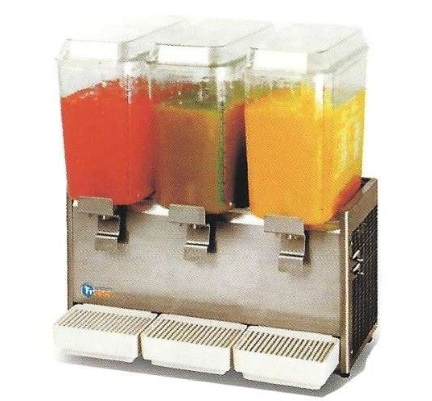
I still remember the order of the drinks inside. The pale white one was soy milk. The tea-colored one was milk tea. The clear orange one, naturally, was orange juice. One might ask why cold drinks were being sold around the New Year. The answer is simple: this is Guangdong. Freezing days may occur, but they are not the norm. If the weather is warm during the holiday, wanting a cold drink is perfectly reasonable.
Strictly speaking, that machine had little to do with the New Year. But children remember what catches the eye, and parents usually do not buy drinks casually on ordinary days, so the image stayed with me. After thinking about it enough times, I tied it together with the act of buying New Year goods. Whether I actually drank one once or twice, I no longer know. Perhaps I did, because I still have the memory of hesitating over which flavor to choose.
As for the so-called milk tea in a machine like that in a small county market, it was probably just creamer, flavoring, and sweetener. A cup would certainly have taste, though it may have contained every kind of essence except detergent. Still, once in a while, it probably did no great harm.
Market day
One thing not to miss when returning home for the New Year is market day.
The village’s location is awkward. Administratively, it belongs to one district, but physically, the nearest convenient place is in another. As a result, whether children go to school or adults go to market, people habitually head toward the latter. It is probably another compromise forced by inconvenient roads.
Market day is one of the few genuinely lively occasions. Its main purpose is to give rural residents nearby a fixed time and place to buy things, so beyond farm produce, all sorts of odd objects appear: hanging pictures printed with strangely dramatic landscapes, clothes that are always in clearance sale, newly forged kitchen knives, trendy appliances of uncertain age.
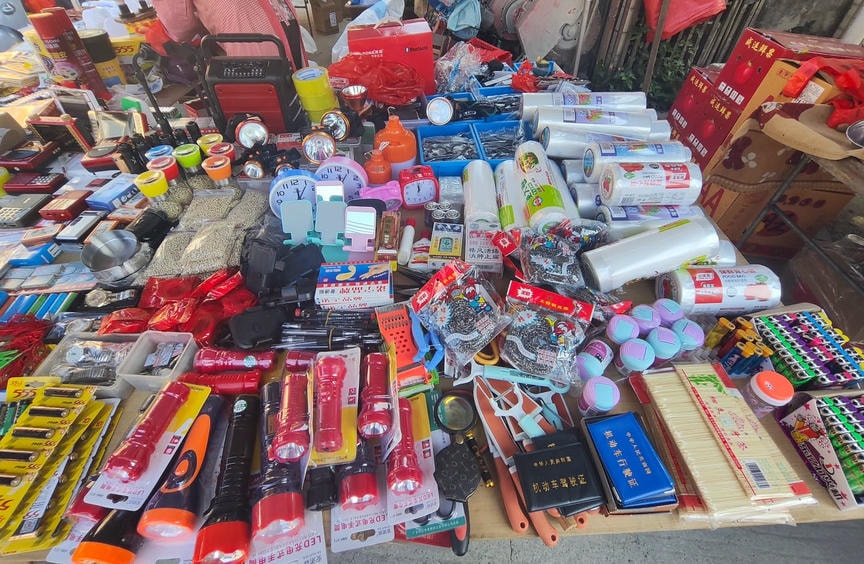
The market has a way of leading small waves of consumption. Seven or eight years ago, LED lamps appeared in large numbers on market stalls, and soon many households stopped using old energy-saving bulbs and fluorescent tubes. More recently, stalls have been selling various solar lamps: a solar panel connected to an outdoor spotlight. In rural areas where power cuts occasionally happen, public lighting is scarce, and snakes or other troublesome animals may appear, almost every household bought one and installed it under the eaves. At night, it lights up.
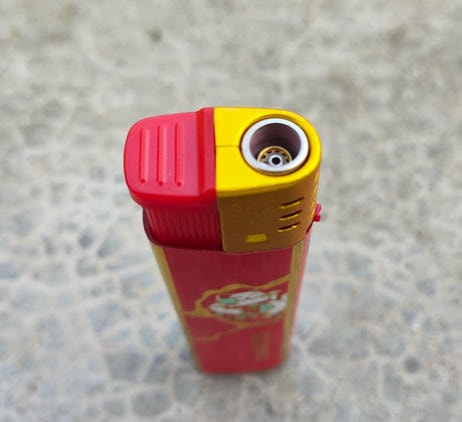
When I was young, I usually went to the pre-New Year market with my grandparents, so the trip did not feel entirely free. This year was different. I could ride the family’s little electric scooter there myself, wander around, and spend my own money on whatever I liked. The stalls still had plenty of strange things. But because the quality of many items seemed doubtful, I ended up buying only a windproof lighter.
It is a direct-jet type, fun to use and quite powerful. Because it costs about twice as much as an ordinary lighter and nobody at home smokes, the adults were reluctant to buy one when I was small. In that minor way, it became a childhood regret.
Looking for friends
The old village is remote, and it can be lonely.
When I was in third or fourth grade, there was still no internet there. Once television became boring, I had to find other amusement. One of these amusements was called looking for friends. The method was simple: I would go to the other end of the village and play with the children from those few households. They were two or three years younger than me.
What we played depended on what happened to be available. If someone had fireworks, we set off fireworks. If they brought out a deck of cards, we played cards, often Big Two. Later there was another activity: watching movies. Of course, this did not mean going to a cinema. It meant inviting them to my house, plugging a player into the television, and watching cartoons that had already been downloaded. I remember Happy Q-Bot, Tom and Jerry, and Bob the Builder. It should have been those.
Looking back, this so-called looking for friends was probably more one-sided than I understood. I do not know why I named it that then. Perhaps the word friend was the only word I had to describe a relationship among several children. But in truth, we were not really friends.
For one thing, we only met a few times a year, usually around the New Year. For another, we gathered because of certain objects or activities, rather than gathering first and then deciding what to do. Most important, our personalities were quite different. A few years later, after everyone grew older, the custom quietly ended. But because it did exist for a while, it deserves to be written down.
The riverside shop and fireworks
If we wanted to buy fireworks but did not want to drive several kilometers to the market, we had to go to the riverside.
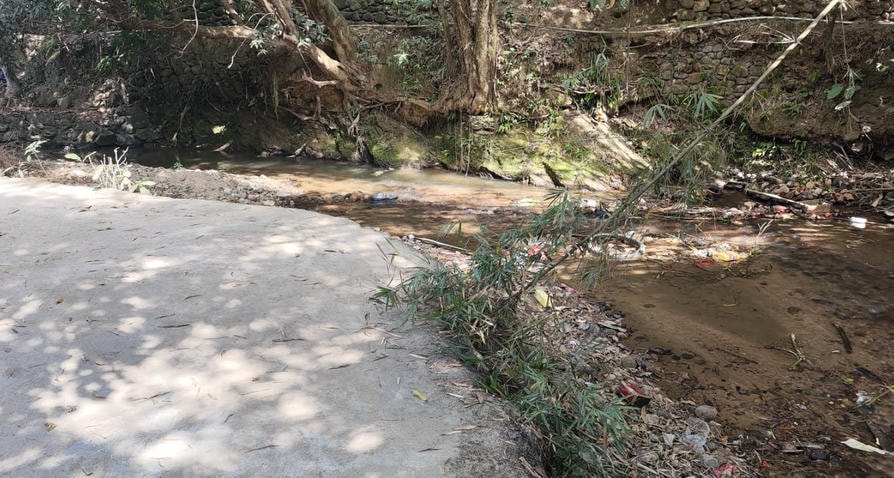
The riverside was exactly what the word says: a small river, plus a few houses beside it. It mattered only because one of those houses was an old little shop.
The river was not very clean. Much of it was exposed, so rubbish and wastewater could fall in, and upstream people kept ducks and geese in the channel. In the shallows it might look clear enough to see the bottom, but wherever the water was deeper, it quickly turned muddy. Steps had been built along the bank in earlier years so people could go down to wash clothes. Because of water quality and the wider availability of tap water, those steps had probably been abandoned for quite some time.
The shop itself was not in great condition either. There were not many households nearby, and young people came back mainly during the New Year. The shop likely saw very few customers most of the year, so over the past decade it had become more and more run down. Many things inside were close to expiring or had already expired, especially food. But for non-food items, a short expiration did not matter much. At worst, shower gel might not foam properly, and fireworks might not be very loud. Nothing too disastrous. So one could still buy things there.
The shop did not carry many kinds of fireworks. Large ones were out of the question; those had to be bought at the market. But for entertaining children, it had enough: sparklers, double-bang firecrackers, snap pops, friction firecrackers, and little nameless things that spun and hissed while throwing sparks after being lit.
As a child I liked buying fireworks there. They were relatively cheap, the selection was enough, and there was no need to travel far to the market. Buy them and use them immediately. The thing I bought most was probably sparklers. Once lit, they spat sparks with a steady hiss and burned for quite a while. The simplest way to play was to wave them around after dark. But boys seldom leave simple things simple, so new methods soon appeared.
One was burning them in water. After lighting a sparkler, I would stick it into water. Because the powder contained magnesium and oxidizers, it could keep burning, bubbling away underwater.
Another was using them like a blowtorch. I would find a discarded brick with a hollow in it, or dig a small pit in the soil, place something inside, light a sparkler, and aim its flame into the pit to see whether the thing could melt. Even if nothing was placed there, the pit would be left with combustion residue, often including little balls hot enough to glow red.
The more violent method was to take apart a whole bundle of sparklers, pour the powder into an old bowl, crush some charcoal, and mix it into the firework powder. Once there was a full bowl of that mixture, the possibilities seemed unlimited.
None of these ways of playing with fireworks was safe. I still do not know why nothing serious happened, so it is better not to imitate them.
Pine wood, zongzi, and the big stove
In parts of Guangdong and Guangxi, people make zongzi for the New Year.
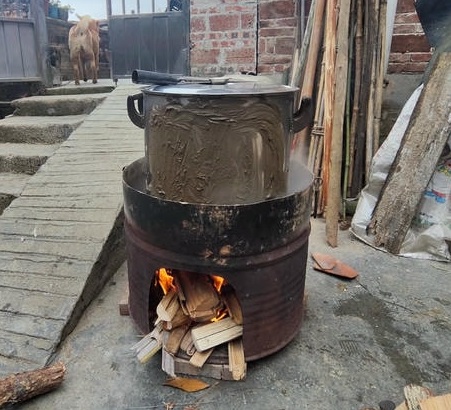
Around the twenty-fifth day of the twelfth lunar month, the household would begin soaking glutinous rice and beans, preparing cured pork, and wrapping zongzi. The wrapping process itself is not especially dramatic: add some rice, beans, and meat, then fold and tie everything according to the proper method. It sounds simple, but because it is long, repetitive work, it is still tiring.
After the zongzi are wrapped, they go into the pot. The quantity is large and the cooking takes time, so the regular wood stove used for daily meals cannot be occupied by them. That is when the metal barrel stove in the small room next door becomes useful. A large supply of dry pine and fir is prepared. First, thin dry bamboo pieces are used to start the fire. Once the firebox warms up, thicker logs are added gradually, keeping the water in the big barrel boiling so the zongzi can cook slowly.
Someone has to watch the fire. If the firewood runs low, more must be added. But one cannot simply stuff wood in nonstop; there must be room for air to enter. Otherwise the stove produces smoke without flame, and the water will not boil properly.
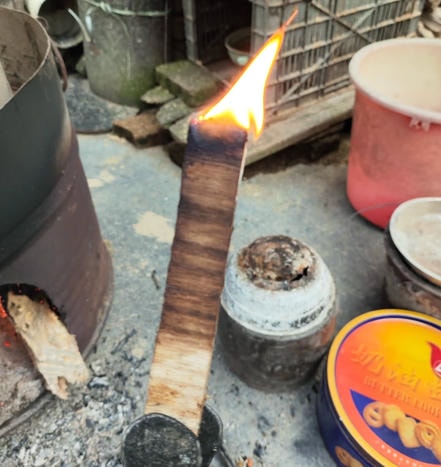
This job has an extra benefit: the stove becomes extremely hot, so one can warm oneself beside it. I have always liked playing with fire—not setting things recklessly ablaze, but lighting one end of a bamboo strip and watching it burn. The picture at the beginning is nothing more than a small wooden stick dipped in leftover beeswax. So naturally I never wanted to miss this job. When the cold wind was blowing outside, there was a hot stove to sit beside and fire to tend. That was a fine arrangement. One only had to avoid going too far, avoid lighting things that should not be lit, and keep the stove burning properly.
This winter has been unusual. The temperature has been too high, so warming oneself by the stove feels inappropriate and not especially enjoyable.
Saving charcoal
Watching the fire does not only mean adding wood. From time to time, larger pieces of charcoal inside the stove have to be picked out and placed into a prepared container nearby.
This cannot be done carelessly. If a piece is still flaming or smoking after being picked up, it has not burned through properly and should be returned to the stove. The tongs must also be used gently. If too much force is applied, the charcoal breaks apart easily. Pieces that are not too small can still be shoveled into the container. If they are too fragmented, they can only be left to burn away.
The stored charcoal has three main uses. It can be used with a small charcoal stove to simmer slow-cooked soup. It can be saved for barbecue at Mid-Autumn Festival the following year. Or, when the weather is especially cold, it can be brought out for warmth.
But these days, rice cookers and gas stoves can make soup, so the charcoal stove is used less often unless the quantity is large. Mid-Autumn Festival is not close at hand. And this year has not been cold; at times we have even needed an electric fan. So the full container of charcoal still has to be stored in the little room next door, left to sit somewhere cool.
A New Year’s Eve dinner that does not wait until midnight
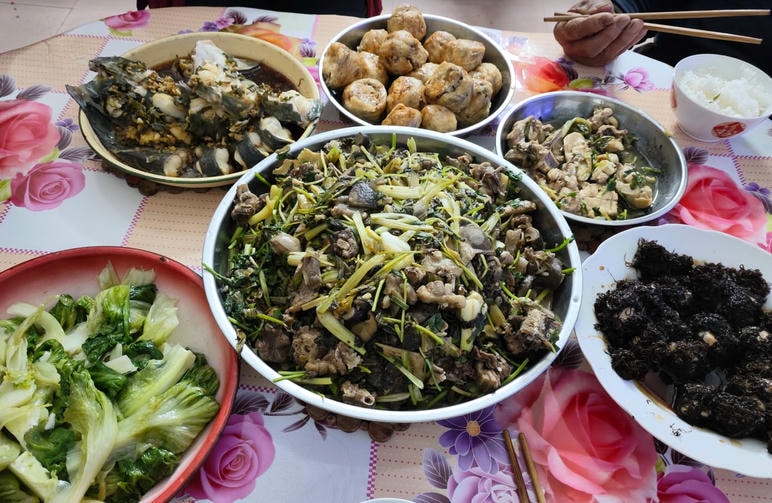
In some places, people are said to eat New Year’s Eve dinner at midnight. I am not sure how true that is. In my old village, the meal is not so late. It is simply an especially abundant dinner. And there are no dumplings. In Guangdong and Guangxi, wheat-based foods are not eaten nearly as much.
In times when productivity was low, a New Year’s Eve dinner—or any festival meal—must have been a luxury. There are many glimpses of this. The old house, as I said, is a kind of time capsule. Besides that composition book, there were also some Chinese readers from the 1970s or 1980s, with pinyin, likely meant for lower grades. One article described a similar holiday scene. It was not the New Year but Mid-Autumn Festival. Ordinary households offered fruits to the moon; wealthy households offered wine and dishes. The writer’s family, however, had only a plate of wild jujubes.
Another example came from a reading comprehension passage I encountered in middle school. On New Year’s Eve, other families were making dumplings, but the writer’s family ate a dish made by grinding a little soybean for tofu and mixing it with dried bitter greens. That was their holiday meal.
Against that background, a full table of dishes is not merely a full table of dishes. Even if one does not say grand things about it, the abundance itself carries meaning.
Chocolate under small red lamps
At midnight, firecrackers are set off. Another indispensable item is a temporary offering table.
Imagine a folding table about the size of a small tea table. On it are two lamps, some preserved sweets such as candied winter melon, candies, chocolates, apples and oranges, and three cups filled with tea. It is, plainly, an offering.
The lamps have their own rules. Generally, from midnight at the start of the first day of the New Year, they must remain lit until the fifth day, without going out. For that reason they are turned down to the smallest possible flame, almost no larger than a pinhead. They also need to contain some red. Similar small lamps are placed in each room, including the kitchen, so that the God of Wealth can find his way.
In earlier years, kerosene lamps were used, with a small piece of red paper pasted onto the glass shade.
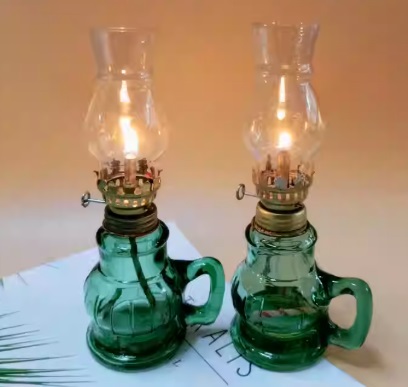
Later, as time moved on, imitation kerosene lamps with incandescent bulbs appeared on the market. Plug one into the wall and there was no need to add oil. Later still came battery-powered LED lamps. Whatever the technology, they were red.
I have heard there is now such a thing as electric incense as well: three incense-stick shapes with three tiny red LEDs at the tips. Plug them in and they glow. Time really does move quickly. Even this can keep up with the age. One wonders what the gods make of it.
The village’s own festival
The twenty-eighth day of the twelfth lunar month is already here, and tomorrow is New Year’s Eve. In recent years there has been no thirtieth day in the lunar month, so everything arrives a little sooner than the phrase New Year’s Thirty suggests. I wanted to put down these scattered memories before the moment passed.
There may not be the dreamlike festive atmosphere I once imagined from books: no bright lantern streets, no crowds at the village entrance, no performances rolling through the morning, no packed courtyards crunching under sesame stalks. But the people in the small mountain village are still observing the holiday seriously. They follow customs that have come down from long ago, in whatever form is still possible, and after a year of work they give themselves a reason to pause.
Year after year, some things remain and some things change. By next year, who knows what will be different.