On May 14, Redmi revealed that its first flagship would be called the Redmi K20. The name immediately sparked debate: why start at 20 instead of something like Redmi K1? Many people quickly linked it to the upcoming Honor 20, arguing that Redmi had chosen the number on purpose to ride the comparison.
That kind of rival-brand baiting is usually left vague enough for people to infer on their own. What made this episode unusual was that Redmi general manager Lu Weibing openly addressed it on Weibo. His explanation was that the K in Redmi K20 stands for Killer—in other words, Redmi K20 is meant to "kill" the Honor 20.
That is a remarkably blunt way to frame a product name. Competitive marketing has always existed in the phone industry, from earlier attempts to imitate Apple’s style to endless battles over who has the “best camera.” But turning the product name itself into a provocation still feels like a new low.
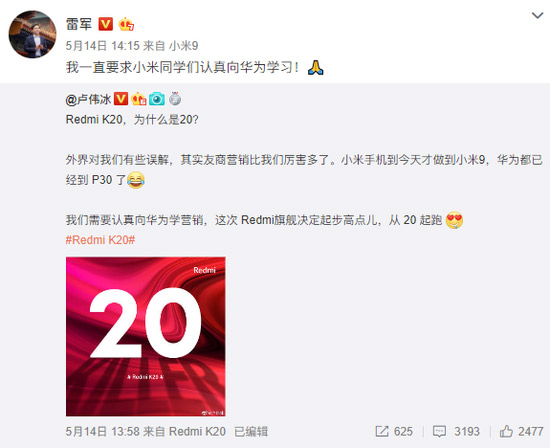
And just when it seemed the story had already gone far enough, Lei Jun added another post. He wrote only one sentence: “I have always asked Xiaomi colleagues to seriously learn from Huawei.” The comment was a response to another post by Lu Weibing.
Lu’s post said:
“Some people have misunderstood us. In fact, our competitors are much better at marketing than we are. Xiaomi phones have only reached Xiaomi 9, while Huawei is already at P30. We need to seriously learn marketing from Huawei, so this time the Redmi flagship decided to start from a higher point and begin at 20.”
The logic behind these posts is hard to take seriously.
Lu Weibing’s argument seems to be that if a competitor’s model number is larger, that somehow proves stronger marketing. But how does a numbering system demonstrate marketing strength? If bigger numbers really meant better marketing, Redmi could have skipped straight to Redmi 1000 and guaranteed that Honor would not catch up for a decade. Even a more restrained jump to Redmi 30 would have put it one full generation ahead of Honor on paper. Instead, Redmi chose K20, and even added a K for effect.
Lei Jun’s response is not much more convincing. If Xiaomi is supposed to learn from Huawei, the obvious lesson should be Huawei’s commitment to R&D and innovation—not simply the naming of its phones. If the neighbor names their child Zhang San, does that mean your family should name yours Li San? That is imitation for imitation’s sake.
Since the launch of the Redmi Note 7, Xiaomi’s attempts to needle Huawei have become increasingly obvious. That likely has something to do with Xiaomi’s sharp decline in domestic sales, a problem that has been apparent for some time. It is understandable for the company to feel pressure, but brand baiting alone is unlikely to reverse falling sales.
Consumers did not abandon Xiaomi because they were not hearing enough about the brand. They left because the phones no longer offered enough standout features, and because Xiaomi has not shown much that feels genuinely innovative. More exposure cannot solve that by itself.
The situation is similar to what happened after Brain Platinum changed hands: even though advertising remained heavy, sales still dropped sharply because people had already lost interest in the product itself. When demand weakens at the product level, more ads do not fix the problem.
What Xiaomi needs now is not louder marketing, but stronger research and development. The company has to reshape its image through real innovation instead of relying on publicity stunts and constant comparisons with rivals. Huawei, for example, was willing to open-source the Ark Compiler with a more open posture. Xiaomi, by contrast, still seems preoccupied with attention-grabbing rivalry. If it does not start making up ground in substance, the gap may only widen further.