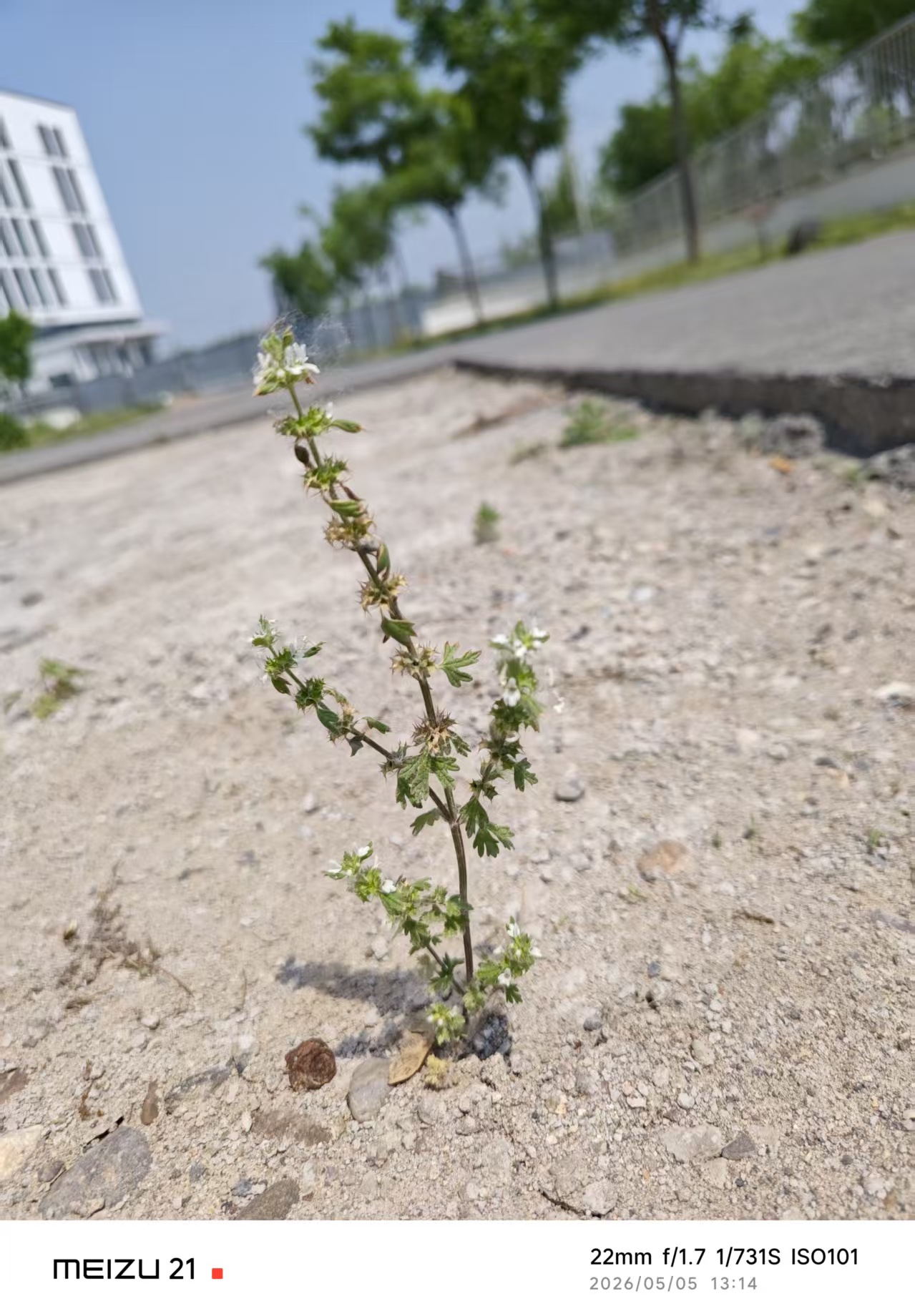
After lunch, I took a walk and stopped by the east side of the entrance to Building 4 at NBIC. There, in front of a small plant, I found myself crouching down and staring for a while.
There was nothing generous about the place where it grew. It used to be asphalt road. The asphalt had been cut away and removed, leaving the cement layer underneath exposed, with bits of gravel scattered across it. Yet from that poor, hard ground, a tiny plant had managed not only to live, but to bloom. It swayed in the wind, among drifting poplar catkins, as if this were the most natural thing in the world.
Some things look utterly ordinary. Some only seem to be surviving in silence. Then one day, without warning, they become a small miracle of life. Behind time, there are always so many stories.
After looking it up, I was even more surprised. This little plant has a name connected with the traditional solar terms: Xiazhicao, the “summer solstice herb.” In modern botany, there is even a genus in the mint family named after it. Once the summer solstice has passed, its leaves begin to yellow, and its life moves toward its end. That is how it got its name. Today happens to be Lixia, the Beginning of Summer. A coincidence, perhaps, but a meaningful one.
These past two days, I have been thinking about time more than usual. The feeling came from the preface Sanmao wrote for The Rainy Season Will Never Come, the one titled “When Sanmao Was Still Ermao.”
In 1976, in the Canary Islands of Spain, Sanmao was thirty-three. She had just moved there with her husband, José. I imagine her sitting by the window of a small house near the sea, chin in hand, paper and pen on the table. The three years she and José had spent together in the Sahara had made her gaze clearer, gentler, more open. Looking back at the essays she had written in her youth, she reflected and wrote:
“The reason human beings are sad is that we cannot hold on to the years, and we cannot deny that youth will one day disappear so naturally.
Yet what is precious in us also lies in the fact that, through changes in time and circumstance, we grow in life. The passing of years is something we cannot help, but a person’s gradual transformation is also inseparable from the power of time.”
She then asked why the Ermao who had once been seen by her parents, relatives, and friends as a problem child could, ten years later, become a woman who had love, faith, and hope for everything. In her own answer, she could not get away from two ordinary words: time.
For Sanmao, time was not something she simply watched from bed as it rushed past like a great river. In those ten years, countless journeys, endless wandering, and emotional hardships had not been allowed to waste the most precious period of her youth. When she picked up the pen again, the person writing was no longer that sorrowful, sensitive, romantic, and irresponsible girl called Maomao.
She also wrote:
“I am an ordinary person. I grew up in an ordinary way and did the foolish things ordinary young people do. Even now my life has not settled down, but in my view of life and in my state of mind, I have reached another level. I have grown. That does not mean I have aged, nor does it mean I no longer work for my future. But my state of mind is now like a boundless clear sky, like a vast sea: calm, peaceful, detached. I am not naïve in dealing with people and affairs, but I still look down on slickness. I am not extreme. I even feel grateful toward every person, because life is built together by human beings. Without others, there could be no me.”
And later:
“People can change; each person simply needs time. I often think that the tragedy of fate might better be called the tragedy of character. How we pass through our lives is the question. It is of course valuable to remain steadfast and unchanged, but sometimes it is also necessary to search for other joys in life; that too is an effort and a goal. What is a healthy life? For me, it is to keep merging myself into the realms I am able to reach. In my heart there is an unchanging faith. What it is, I do not know clearly, but I will not give up this force that guides me in the dark, until the day I leave the world and return to the place of eternity.”
I have quoted at length because I love these words, and because I have read them again and again. They fit my present mood almost exactly. Sanmao’s writing is emotional, but in the past two days it has pushed me toward a more rational kind of thinking.
The “time” in that preface, as I understand it, can be reduced to four words: the settling of the self. And this settling is not passive. It requires a certain willingness, even a certain initiative.
So how does a person allow the self to settle? To me, it comes down to two things: going through the world, and tempering the heart.
To go through the world is to enter it, to experience things firsthand and gain breadth of life. It does not mean drifting thoughtlessly with the crowd, feeling nothing and understanding nothing. To experience the world in the way Sanmao did, one first needs two things: the ability to communicate, and courage.
Sanmao’s nature also carried two distinct colors: a longing for freedom and a desire to be loved. These are not necessary conditions for experiencing the world, but because they were present in her, her life appears to us as romantic, like the poetry and distance so many people yearn for.
Tempering the heart is different. If going through the world is our interaction with what is outside us, then tempering the heart is our interaction with our own inner life. In that process, we gradually strengthen four abilities: the ability to perceive, the ability to discern, the ability to endure, and the ability to act.
The ability to perceive, put simply, means not living numb. Whether something is good, bad, or seemingly unrelated to us, we are still able to feel something in response. That, too, is a capacity. And with age, this capacity should not fade. If anything, our sensitivity to things that create positive feeling should grow stronger.
Perception corresponds to emotion. Discernment corresponds to character. When something good happens, how do we respond? When something bad happens, how do we respond? When something has nothing to do with us, what should our attitude be? We need to be able to judge whether our response tends toward kindness or toward harm.
The ability to endure is easier to understand. Whether we meet with good fortune or misfortune, we should not fall into wild ecstasy or wild grief. If we can still act rationally, that is psychological endurance.
The ability to act is the key point in our interaction with the outside world. It is not enough to think; we must also do. Through correct action in the world, we are able to preserve our confidence.
As for the unchanging faith Sanmao mentioned in her preface, the one she said she could not clearly name, I think it can also be expressed in four words: live well, truly.
After the life experience of the Sahara, with José beside her, the sea close by, and readers across the ocean who loved her, Sanmao in 1976 must have been happy inside, peaceful and settled. That is why she could write such a preface, full of reflection on life. In that short piece, her frankness is everywhere. With emotional language, she expressed a spaciousness of mind that only life itself can carve out.
And yet fate can be cruel. Three years later, José died in a diving accident. Sanmao never truly emerged from that shadow. Twelve years after that, she left the world in the most final way. The person whose words warmed so many others was, in the end, unable to warm herself.
My thoughts stopped there, abruptly, in sadness.
I casually turned the calendar and saw that June 21 will be the summer solstice. In a little over a month, the summer solstice herb growing from that crack in the cement will probably wither. Sanmao is gone, but her words are like the seeds of that plant, hidden behind the years.
When spring comes again, the summer solstice herb in our hearts will still grow stubbornly, no matter how poor and hard the road of this world may be.