May already.
I’ve been blogging less lately. Part of it is simple: work finally got busy enough that I no longer have the spare attention to sneak in blog posts during the day. This year has been unexpectedly hectic, and my role has shifted along with the actual work I’m doing. There was some vague talk about a raise, but nothing has really changed; I’m still covering a pile of administrative tasks that were never supposed to be mine. By the end of the day, the density of communication is so high that when I do get free time, I often don’t even want to go online.
The other reason is that fandom has eaten a shocking amount of my leisure time. I counted the other day and realized I’ve already written 60,000 words this year, not even including unfinished things I never posted. It doesn’t sound like much, maybe, but last year I wrote only seventy to eighty thousand words total.
This year I also finally started seriously pushing forward on the Infernal Affairs brother-centric fanbook I’d been meaning to make. The original plan was to do it last year. At the time I calculated that I’d written around 150,000 words in that corner already, and most of the things I especially wanted to write had more or less been written. I even found a proofreader. Then that person ghosted me completely, and I got discouraged enough to shelve the whole thing for half a year.
This year, though, I kept receiving all kinds of small free fan-made gifts from different people online, and that made me feel I ought to make something too. So I picked up the plan to print Against Heaven’s Will again. I rather suddenly got the proofreading done, made light revisions to a few pieces, and commissioned the cover and layout. Outsourcing all of that really does make things much easier. The plan is to get a proof copy first, then maybe post about it on Mastodon.
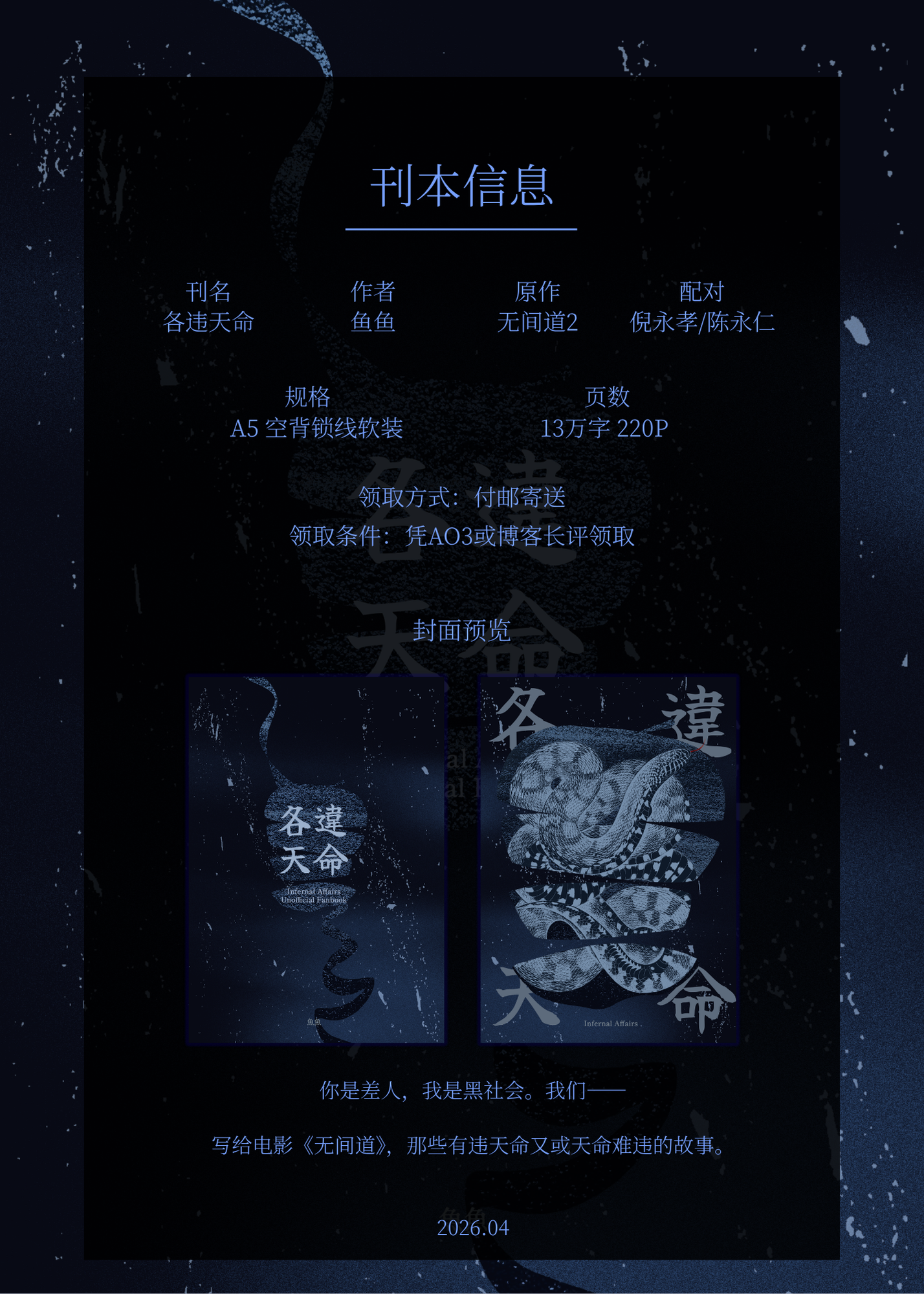
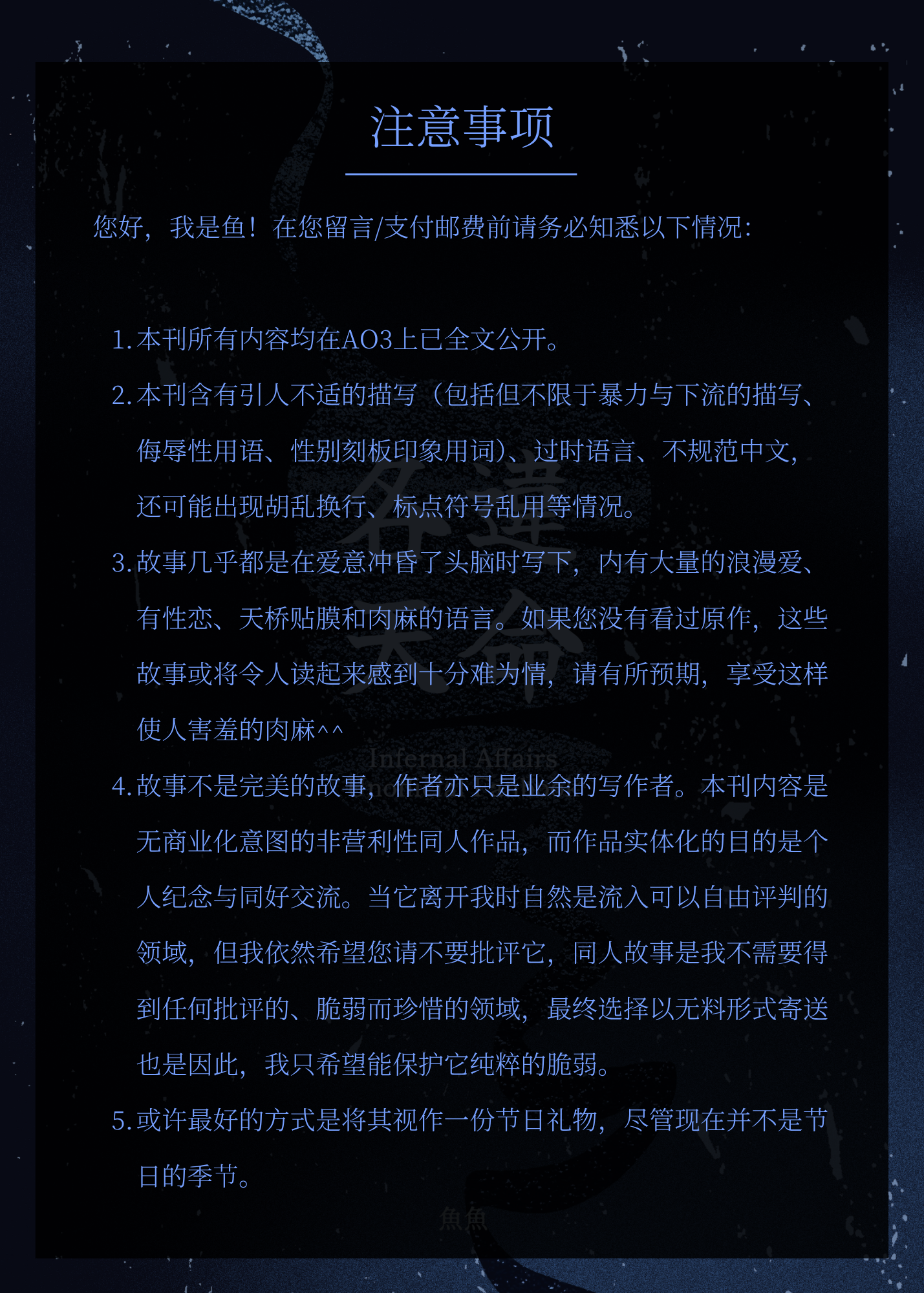
From the start, this was never meant to be a large print run, and I never intended to sell it. Although I’m still not entirely sure whether “just pay postage” counts as free distribution or not. In any case, the budget is basically: if I can keep the whole thing, including the actual print run, within 1.5k, that’s enough.
Someone suggested pricing it at cost. But the real reason I want to print it in this fully subsidized way is that I want to retain some choice over how it will be evaluated.
Rereading some of these pieces this time, I can’t claim they’re perfect fiction. The plots, the word choices, the ways they were written—there is something a little embarrassing about them. But not shameful.
I don’t feel ashamed of them. What I want is for these undeniably embarrassing things not to be criticized, not to be sneered at, not to be treated as curiosities. I want to be able to choose that. More than any sensitivity around the text itself, that is almost the real reason I’m doing this. I’m not interested in turning this into one of those discussions about whether it’s immature to write and then refuse negative evaluation. There’s no need.
To me, exchanging that choice for this kind of cost feels perfectly fair. I can’t say it’s because these stories are uniquely special. But the period of my life bound up with Infernal Affairs really was a stretch of time with almost no impurities in it, a period of unusually high purity. I want that purity to continue. I want that kind of time to remain forever, and of course that means I have to make some effort for it. I’m trying not to be greedy, or to take things for granted.
That’s one fandom matter. The second is that not long ago I watched season three of Squid Game.
I complain about this series every season, and yet somehow season three was the one I complained about the least. Even more unexpectedly, season three made me start shipping an incest pairing I didn’t even ship while watching season one. What the third season clarified for me was this: the uncle is committed to being a bad woman all the way through. He will not explain himself no matter what. The younger brother searched for him for three seasons, and when they finally meet, the uncle doesn’t want to say a single word before leaving again. He truly only loves being a bad woman; the younger brother means absolutely nothing to him except as someone who’ll clean up after him. By the final episode I was dizzy. What do you even call that? The instant your love for them ends is exactly when mine begins.
As for everything else, I don’t really have much to say. My feeling toward this IP is basically that I have no feeling. Everything except my favorite character passes before my eyes and disappears as quickly as bottled water poured into a river. But over the May holiday I did at least make a fresh fanvid.
If I remember right, “Bury a Friend” was the theme song for a newer season of True Detective. I’d kept it on a playlist ever since I heard it. My editing skills, and my ability to understand the relationship between lyrics, music, and image, are both pretty average, so I’ve realized that fast songs with a strong beat and very clear cuts are easier for me to work with. That’s usually the range I choose from. It’s not an especially perfect fit for the little cat in question, but I’m quite happy with several of the “When we all fall asleep, where do we go” moments.
Meanwhile I’ve also been writing an ABO mpreg fic about the uncle, called Sheep Doll. Writing and editing this much makes me look like some die-hard Squid Game devotee. Uncle, you are making me lose face.
Because the premise felt novel, I rode the hormonal rush and wrote a great deal of it in one go. But during this same stretch I’ve also started feeling that writing itself has become difficult. I can still write, technically, but the sensation is strange. It feels as though the instinctive way I wrote for the past ten years has stopped working. Even basic connective tissue—cause and effect, “and then,” all those transitions that move a sentence forward—now has to be reread over and over before it comes out right. Usually this only happens when I haven’t written for a long time and have gone slack. But I haven’t, have I? I have been writing continuously. I haven’t been neglecting it. So how did this happen?
Trigger Warning: mention of sexual assault. Spoilers for House of the Seasons.
In the middle of the week I watched House of the Seasons with a friend. I went in with no prior context, and then suddenly I had watched House of the Seasons. The feeling afterward was almost like swallowing a stone. I was not prepared to encounter a story like that on a weekday night, especially with another workday waiting the next morning, no matter how lightly the film presents itself. To avoid misunderstanding: it is a very good film.
For a long time I’ve admired a detail in the work of the writer Chang Yi-xuan: when the child is assaulted at too young an age, the child has no way of knowing what the violation is, and so cannot articulate it. That thing is wrong. But what exactly it is cannot yet be named, cannot yet be brought into language. In House of the Seasons, when Mi-do takes extra tutoring money, she feels inwardly that she ought to receive that much. When the assault happened, she did not yet know it was assault. I have only encountered this kind of thing in the works of these two creators: that blurry, unspeakable, speechless but undeniable thing that happened, that fact which exists before it can be named. Later we keep learning language, and only afterward do we recognize what it was and gain the ability to describe it.
I feel a little sorry saying this, but the first time I read that passage by Chang Yi-xuan, I immediately thought that she and I must share the same experience. By now I know more clearly that she exceeds any neat summary like “having had one particular experience.” She is too good a writer to be reduced that way. Watching House of the Seasons gave me a similar feeling. For days I kept thinking about the car-wash scene, and what surprised me was that what struck me was not emotion but information.
It still feels almost unbelievable to me: a mother who runs a kindergarten, someone so familiar with children, still failing to realize that her own child is being assaulted continuously. In 2024, when I told my mother what had happened to me, her first reaction was also: but you were so young then.
Chang Yi-xuan once found an extremely precise word for my mother’s reaction and mine in that moment: explosion. Over the phone, when I told her, both my mother and I heard an enormous explosion. Yes, I said—there are people like that. When I said it, the more accurate word for my state now might be dissociation. But at the time what I felt more exactly was that my soul had left my body. I wanted to tell my mother, and really to tell everyone: yes, this society contains people like this. We live in a world where people do vile things to very small children. Please do not refuse to believe it. I can stake my life on the fact that it is true.
In Yoon Ga-eun’s film, Joo-in asks her mother: how could you not have noticed? Again, I feel a little sorry saying it, but at that moment I had the same thought I once had with Chang Yi-xuan—that perhaps Yoon Ga-eun and I shared the same experience. Or perhaps, again, she has also gone beyond the limits of any one experience. Or perhaps she is simply a director who did extraordinarily good research. I say that because every detail is so, so, so accurate: the victim is an extremely young child, the parents do not notice, truly do not notice, remain completely unaware. Then of course the perpetrator is someone known to the family.
Afterward I kept wondering what led Yoon Ga-eun to give Joo-in what people would call such a typical history, or whether the overlap of those three traits is simply that inevitable. Or maybe it is only that we really are that similar. There is another point of overlap too: I told my mother; my older brother knows as well; in fact, he was the first to know, back when we were both still children. But I have never told my father, and there is no possibility that I ever will.
Because this, too, is true: children can withstand extreme horror better than adults can; men are more fragile than women; and fathers are, naturally, even less able than mothers to bear such a fact. I have always known that the world works this way, not according to the obvious script about who is supposed to be strong and who is supposed to be weak. House of the Seasons is written that way too, and so is Book of Farewells: the person least able to face the truth is precisely the father. If you ignore profession and sibling age differences, Joo-in is almost me, and I am almost Joo-in.
One more thing. When I first read Book of Farewells, I thought it was something purely rooted in private experience, because Chang Yi-xuan’s writing was so difficult for me to put into words that it felt like a dictionary in itself. But now, after seeing House of the Seasons, I’ve started asking a question I would not have asked before: maybe this is also a matter of craft.
The intuition of women writers, their extraordinary technical ability—I believe their work is this good partly because some things are private. But private does not necessarily mean only the directly experienced can reach it. It may also be something that can be achieved through real, serious field research. Sexual assault is a very special subject, something like war and yet not quite like war. We tend to think that only those who have lived through war can write about it in a convincing way, and we often think the same about sexual assault. But war leaves archives, wounds, medals, traces. Sexual assault does not, not in the same way. So what if, as we now write war novels, we also wrote stories about sexual assault through sheer craft?
I keep wanting to believe that what I am seeing in these writers and filmmakers is simply magnificent technique. But even writing this, I feel uneasy. I want to talk about a possibility in writing, not pry into anyone’s privacy. So I’ll stop there.
The reason I’m writing any of this at all is that thinking about this film has made me profoundly tired. In the story, Joo-in jokes with a male classmate, trying hard to sound casual: see, one mention of it and you’re terrified already. To a female classmate she says, in a placating tone, I really don’t feel that bad about it. This is not exactly about disguise. It is about exhaustion. People are always fragile. In fact, the better a person is, the more fragile they often are.
To borrow again from Book of Farewells: people simply cannot bear the fact that someone close to them has lived through an explosion, something as enormous as losing arms and legs. I have always, always wanted to tell people that the ones who need the trigger warning are not people like us. The reason I was unable to speak of this for so long was not because I could not bear it, but because it would be too painful for my mother, and for the people who love me.
Not long after I learned to read, I also learned how frequently such things happen in our society. Because of that, I never felt uniquely alone or impossible to understand. But I did feel a heavy sadness: why can’t we talk about these things in an ordinary way? Only because ordinary people are so fragile. I do want to talk about it. It’s not that I have no thoughts; it’s that I have far too many thoughts. Being hurt is not, to me, some unspeakable thing. It is simply something most good people cannot endure hearing about. I may want honest intimacy with others, but I also cannot show someone a video of a child being struck by a car and flung into the air. Is it other people’s fragility that exhausts me? What truly overwhelms me, I think, is the desire to protect the fragile people I love. And yet I cannot not write. I cannot not speak.
Writing and speaking are how I face most forms of suffering. That is why I remain deeply grateful to the friend who once recommended Book of Farewells to me. I wrote once on social media that when I was learning to ride a bicycle as a child, the bike had a training wheel attached at the back—not the usual pair, but a slightly higher wheel mounted on the right side of the rear wheel. Whenever the bike wobbled and lost balance, you tilted right and that wheel caught you. It was a very effective way to learn; it supported you while training your intuition. Once you learned properly, the wheel came off and the bike became an ordinary bike.
In some sense, Chang Yi-xuan has been my training wheel. When I hadn’t yet thought something through, when I still couldn’t say it myself, I could hide behind her novels. I could stand behind her precise and dignified language, behind that dictionary of hers, because she is the stronger person. And I could take a little more time.
Most of the moments in which I feel calm and safe are moments when I feel I don’t have to express anything at all. The most beautiful and precious things in me do not need to be said, and do not need to be written either. As long as Book of Farewells exists in the world, I feel I do not need to explain. It probably sounds unambitious for someone who writes stories to say this, but I truly feel that enough has already been said. Borrowing her expression is enough for me.
House of the Seasons gave me something similar in another respect too: the film’s remarkably light, lively current of romance. Despite having gone through such a supposedly typical experience, I never had the kind of PTSD response that is common in anti-assault films. In adolescence and later, experiences of love and sex were never particularly fraught for me. I read many books afterward and felt little resonance, and I often wondered whether that was because I was fortunate, or because those things are not actually linked in any necessary direct way.
I’ve said before that I need role models. Whether that figure is fictional or real, if I don’t know that someone else can live a certain way, then I become confused trying to live that way myself. So seeing that Joo-in was like this too made me feel that there are in fact many, many people in the world who are like this.
I had meant to write more about the prayer scene at the beginning of the story, but it feels too minor to unfold at length. Still, one detail stayed with me: my mother later did something similar, and we were praying in a very traditional ancestral hall. The absurd part is that it was a traditional male god. He could not possibly help me.
I am not opposed to prayer or blessings in themselves. I simply think the gods in our world do not act. If they did nothing when violence was happening, then after the violence has happened they are no use either. So if you truly love me, please do not pray to such things on my behalf. Don’t insult me with this kind of useless gesture again. There are angrier things I could say, but I also think there is no benefit in them. Anger has no benefit at all. Even in a space that belongs entirely to me, I have no right to spread anger. I know very clearly that only love, sympathy, empathy—things like that—have value.
After the movie, my friend and I talked about several other things. The part that still leaves me puzzled and curious is this: the film is a confident kind of film, the kind that makes you feel tomorrow will of course be better. It gave me the sense that Yoon Ga-eun’s cinematic world has confidence in human beings. People love one another; people understand one another. Joo-in can still joke and roughhouse with a male classmate in that way. She can write down that her aspiration is love. She can meet a boy whose sense of gender is so astonishingly normal. Her younger brother is also such a loving child: “I hope you disappear forever.”
And yet once I step outside the film’s world, I feel a certain unreality and confusion. In a world where gender antagonism is so intense, I found myself watching a film like this. Are we still supposed to hold on to this kind of hope?
Or perhaps the real question is: can we still raise children like this now? Children with ordinary, healthy ideas about gender? Because I doubt it, I found myself distrusting the subplot involving the kindergarten classmate’s younger sister. I kept suspecting that what had happened to her was done by a child her own age, that those marks were caused by boys her age hurting her. People often struggle to imagine how early gender and violence enter our lives. I often feel that boys and girls inhabit entirely different worlds. Even in something as crowded and narrow as the internet, they seem to occupy two separate networks that barely disturb one another. And yet it was Korean women who shouted so clearly: “Our bodies will not give birth to the sex that oppresses us.”
My friend said she did not feel that suspicion while watching the film, and I didn’t sense any suspicion in the film itself either. That is exactly why I am so curious. How does Yoon Ga-eun, after seeing the real world we live in, continue to tell a story like House of the Seasons with such steadiness, such lack of hesitation, such confidence and hope?
At this point I think I’ve said everything I needed to say about the film. We can talk about the rest another time.